Air Cover and Extraction

This is a relative new (e.g. only a few years old) Phrankism for me.  During recent circumstances, I have found myself using the phrase ‘Air Cover’ more often.  As a result, it is probably time to define it and place it in its proper place in the ‘Phrankism-Hall-of-Fame’.

Official Definition(s)

The Free Dictionary: air cover, n (Military):

the use of aircraft to provide aerial protection for ground forces against enemy air attack

The Free Dictionary: Extraction, n (Military):

In military tactics, extraction (also exfiltration or exfil), is the process of removing personnel when it is considered imperative that they be immediately relocated out of a hostile environment and taken to a secure area. There are primarily two kinds of extraction:

  • Hostile: The subject involved is unwilling and is being moved by forceful coercion with the expectation of resistance. Essentially, it is kidnapping by military or intelligence forces.
  • Friendly: The subject involved is willing and is expected to cooperate with the personnel in the operation.

Oxford Dictionary, air cover, noun:

protection by aircraft for land-based or naval operations in war situations: ‘they provide air cover for United Nations convoys of relief supplies

Oxford Dictionary, extraction, noun:

the action of extracting something, especially using effort or force:

Phrank’s Definition

As a Phrankism, it is a military term borrowed to provide good imagery within an organization.  My current working definition (e.g. until someone comes up with a better one and I steal it) is:

The support of one’s superiors, organization and/or colleagues while undertaking an assigned task which involves some risk or need for unanticipated resources.  Generally any guarantees are provided in an informal and often verbal manner rather than via a formal organizational structure.

  • Employee: I have an idea (or the organization has an idea for the employee to completed), I don’t know exactly what resources I will need, how to proceed or what the organization (e.g. colleagues, peers, subordinates, other areas, customers, suppliers, etc.) will think of it, but it is important we try it.
  • Boss: I like the idea and I think it might work.  However because it is new to the organization and involves risk, we will do informally.  However, don’t worry because I will provide air cover and extraction if necessary from the project.  That is I will ensure that you will not be punished, reprimanded and will reasonably receive resources if you request them.

How, When to Use and the Success of Air Cover and/or Extraction

Air Cover and Extraction are based on trust; in particular trust at a personal level between a subordinate and the superior/organization. In this case, the trust includes:

  1. The superior has the resources to provide Air Cover and Extraction.
  2. The superior is willing to use them if/when the time comes.
  3. The employee will know when to and will call for them appropriately.
  4. Once extracted, the employee will not go back to the situation without authorization and thus require further Extraction or Air Cover.

The first two points of trust are top down.  They can also be used to mitigate organizational practices such as Drive By Management or Management through Magical Process.  A word of warning to organizations about trust; the late Steven Covey in his book, The 7 Habits of Highly Effective People, explored the idea of an emotional bank account.  When meeting someone new, everyone starts with a small positive emotional account balance. They then make contributions or withdrawals based on their actions. The more one contributes, the higher the trust; the more withdrawals, the greater the suspicion and lack of trust. In other words, offering air cover and then leaving a subordinate to languish on the beachhead is a sure-fire way to start you down the road of a dysfunctional organization.

Points three and four are about trust going from the bottom up to the top. If your superior is expecting status reports, provide them! If your boss would have helped you out of a pickle – but you never asked – you have violated your trust relationship.

On the fourth point, a person going back into a situation without authorization, works in adventure movies but seldom in real life. Think about the action hero who violates a direct order and heads back to rescue the damsel or save the world. Some by the book superior is cursing him/her as they see the rocket ship/parachute/starship fly away. Nevertheless by the end of the movie, the hero saves the day/world/universe and all is forgiven and the superior is proven wrong.

In the real world, quit when you are ahead. An organization or a boss may rescue you once. Going back and trying again, without permission, is a trust-busting activity.

Formal/Informal: When to Use and Over Use

Air Cover and Extraction can have a formal arrangement. For example, the structure of an organization is designed to delegate authority down and allowed a set of pre-approved decisions to be made by subordinates.

Informal Air Cover and Extraction is a tactical tool the organization can use in specific circumstances.  Like any good tool, its utility is understanding when it is not being used enough (e.g. an organization is stagnate, dysfunctional or moribund in bureaucracy) or too much (e.g. words such as cowboy, free-for-all, loose cannons or out of control are used to describe the organization… and hopefully not by the auditors or shareholders!).

The balance of just enough Air Cover is a sub-theme found in some previous blogs (see list below) and one which I hope to return to in future blogs. What are your thoughts on this?  Leave me a comment but please don’t ‘carpet-bomb’ my site!

Further OrgBio thoughts on the themes of Air Cover and Extraction are as follows… in order of relevance:

  1. Drive By Management
  2. The Propensity to Mediocrity
  3. Top 10 Ways to Guarantee Your Best People Will Quit
  4. Contra-Free Loading: Why Do People Want to Do Good Work?
  5. Collaboration – Not the Vichy Variety
  6. AIIM’s Collaboration Definition
  7. AIIM’s Life-Cycle Collaboration Model
  8. Three P’s and a G over T Collaboration Framework
  9. Collaboration – Is it Hard Wired?
  10. Paying Volunteers – Experience

Drive-By-Management

Drive Bys, Definitions and Dilbert

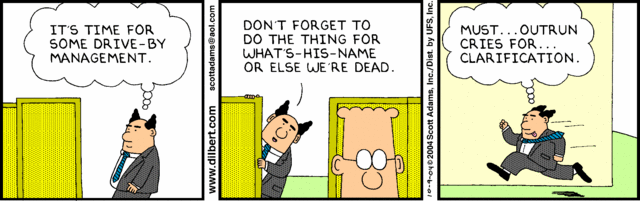
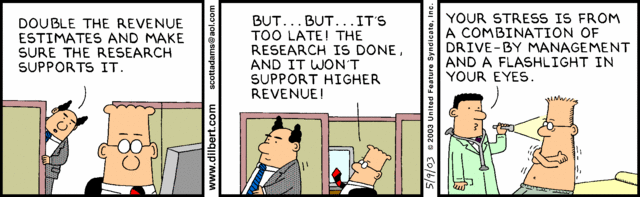
Now that cycling season is over, it is time to get back to thinking about Organizational Biology – and this includes updating Phrankisms.  What really jogged my memory (and motivation) was coming across a couple of old Dilbert cartoons introducing the concept of ‘Drive-By-Management’.

Provide courtesy of www.dilbert.com per the Uclick terms of use policy, all rights reserved by Uclick and its associates.

The urban dictionary defines Drive By Management as:

A management style bearing the characteristics of a drive-by shooting. Typically, this involves firing off pointers at subordinates with a total lack of regard for accuracy or willingness to take personal responsibility. The manager will then make a quick getaway without accomplishing anything.

I am not sure that quite captures my thoughts on the matter so my definition is:

The assignment of work objectives without the opportunity to negotiate the corresponding details to ensure an optimal result. These details may include due dates, quality or quantity measures, the purpose or ultimate use of the output and a discussion on how to improve the quality and productivity of similar, future requests.

John Wayne, the Military and What is the Problem?

So, what is the problem with Drive-by-management? Heck, think of a John Wayne war movie where he orders (or is ordered to) take that hill/building/machine-gun-nest. The doomed squad goes off with determined grit on their face to achieve the objective despite the possible costs. Later, a smaller number return having achieved the objective and saving the day. Hearty pats on the back and more determined gritted-faces follow. What is not to love about Drive-By-Management!

From a leadership position, the ability to send men (and women) off to do the impossible, without the bother of having to provide details or context, sounds pretty good. In reality it does not work that way. Let’s go back to Mr. Wayne and the military example.

Militaries don’t tend to willy-nilly send their soldiers off to certain doom simply because soldiers, in particular modern ones, are hard to come by.  Perhaps the last time we saw such willy-nilly’ness on a large-scale was during the First World War. Thus a military squad capturing a hill is actually not really Drive-By-Management. Before being sent off, the squad has had training on such things. It benefits from resources such as weapons, supporting fire, and communications between it and the rear.  The squad also has a visible objective – the hill/building/machine-gun-nest. After the objective is achieved, it will be carefully documented in the war diary and will likely be debriefed and evaluated by the higher-ups to see what can be learned for the next hill/building/machine-gun-nest. As a result John Wayne and real life equivalents display very little Drive-By’ness.

A better military example of Drive-By-Management in a military context is the Charge of the Light Brigade. If you don’t know the history the summary is there was:

  1. Personal antagonism on the part of the leadership of the English Military leaders,
  2. Poor communication that provided insufficient clarity and details on the objective, and
  3. Unwillingness on part of the subordinate to verify the details and facts before going and charging into what was asked of him.

The result was a great poem by Alfred Tennyson, the death of 156 men, and the loss of a critical fighting force the English could have used later on if it had not been wasted.

Are You a Victim or a Perpetrator of Drive By’s?

This is where the catchy name/metaphor breaks down a bit. Drive-By-Management is easy to thwart by the driver getting out of the car and asking such basic questions as ‘Do you understand or can you do it?’ The person on the receiving end has the ability to stop the car and ask questions such as ‘When do you need it or how will it be used?’ This is where Drive-By-Management meets Management-By-Walking-Around (and the subject of some future blogs).

In the meantime, what do you have to say; have you been a recipient of Drive-By-Management recently? Alternatively, have you been the one doing the driving? My impression is that Drive-By-Management is more prevalent to the public service but I have no real data to support this (and I see yet another blog on the subject). As a result, any comments or perspectives would be greatly appreciated.

Collaboration – Is it Hard Wired?

I have written a series of blogs on the idea and background of organizational collaboration (Vichy, Definition, Lifecycle and 3Ps and a G over T). For this blog, I want to leave the organization and think about the question, why on earth would humans ever WANT to collaborate? In a modern setting, how does it help you by helping a fellow worker resolve a problem that he or she has? Or, go back a few hundred thousand years, why on earth would a hunter, gatherer or human in general want to collaborate?

A possible answer can be found in David Brooks’ book, The Social Animal (and subject of a previous blog). He discusses a “… generalized empathetic sense, which in some flexible way inclines us to cooperate with others. But there is a great deal of evidence to suggest that people are actually born with more structured moral foundations…” [p. 286]. Brooks goes on to describe five possible ‘moral concerns’. These concerns are common to all humans and all cultures and are:

  1. 1. Fairness/reciprocity: equal and unequal treatment
  2. 2. Harm/care: empathy, concern for suffering of others
  3. 3. Authority respect: reverence for and moral outrage against those who disparage authority
  4. 4. Purity/disgust: avoiding social contamination
  5. 5. In-group/loyalty: visceral loyalty to their group even if the group is arbitrary

Compare this to AIIM’s definition of collaboration, discussed in two previous blogs:

AIIM Collaboration Definition

AIIM Collaboration Definition


Humans are likely hardwired to collaborate, cooperate and be part of an organization (be it a tribe or modern organization). That is not to say that we will not look for a chance to advance our own cause (or personal-utility as economists like to say). This is why the collaboration model introduced in a previous blog includes the concept of Governance – someone has to mind the shop.

This of course leads to an interesting question of why do organizations spend time and resources encouraging collaboration – why does it not simply happen naturally? I suspect that a few individuals maximizing their utility obligate an organization to treat all its members as potential miscreants. Thus a few people end up dictating the cultural norms for an entire organization. I call this effect the ‘Propensity to Mediocrity’ and a subject of a future blog.

AIIM’s Life-Cycle Collaboration Model

In two previous blogs (Collaboration – Not the Vichy Variety and AIIM’s Collaboration Definition), I provided an overview to the definition and a lifecycle model of Collaboration. Developed by the American Institute for Image Management (AIIM), in this blog, I want to drill down on the Life-Cycle model. But first a quick re-cap, the definition is…

AIIM Collaboration Definition

AIIM Collaboration Definition

… and the lifecycle model is an eight stage recursive loop:

AIIM's Collaboration Lifecycle

AIIM’s Collaboration Lifecycle


Lifecycle Element Definition
Awareness We become part of a working entity with a shared purpose
Motivation We drive to gain consensus in problem solving or development
Self-synchronization We decide as individuals when things need to happen
Participation We participate in collaboration and we expect others to participate
Mediation We negotiate and we collaborate together and find a middle point
Reciprocity We share and we expect sharing in return through reciprocity
Reflection We think and we consider alternatives
Engagement We proactively engage rather than wait and see

Good Principles – Bad Model

While I like the AIIM definition of collaboration, I have a hard time understanding and using the lifecycle model. The circles suggest that one moves sequentially from one state to another. While I would agree that Awareness is a good starting point, is motivation really the next state? Is engagement truly the end-statement; e.g. everyone in an organization proactively being engaged? Does this not also lead to a lot of organizational noise and tripping over each other?

Some of the states are very important, in particular Reciprocity. I would suggest that this is the most misunderstood aspects of human existence let alone collaboration. Without getting too far into social-evolutionary theory or economic transactional-theory (stay tuned for future blogs); altruism in organizations only gets you so far and often not that much. I know this because I have created numerous Microsoft SharePoint sites which now lie abandoned or have long since been deleted and forgotten. In many cases the underlying business need has come and gone. In others I failed to or stopped providing a reciprocal advantage for erstwhile users (… errr, on that note, thank you for reading this blog).

As a model, I think the Life-cycle is found wanting. However, as a set of principles, I think there may be something there. Read the stages again but this time with this principles lead statement such as the following:

We the members of our organization, where we choose to work, seek to create a collaborative culture and an effective organization through the following collaborative principles:

  • We [choose to] become part of a working entity with a shared purpose
  • We drive to gain consensus in problem solving or development
  • We decide as individuals when things need to happen
  • We participate in collaboration and we expect others to participate
  • We negotiate and we collaborate together and find a middle point
  • We share and we expect sharing in return through reciprocity
  • We think and we consider alternatives
  • We proactively engage rather than wait and see

Thus, I think the AIIM Collaboration Lifecycle can help an organization establish a set of principles to allow for the creation of a collaborative culture. What the lifecycle fails to do though is provide a more robust conceptual framework to build, nurture, evaluate and continuously improve organizational collaboration. To do that, I would like to introduce the ‘3 Ps and a G over T Collaboration Framework’.

AIIM’s Collaboration Definition

In a previous blog (Collaboration – Not the Vichy Variety) I provided an overview of the Association for Information and Image Management’s (AIIM) definition and model of collaboration.  I like the definition as it focuses on people and business objectives rather than technology.  The definition, with my annotations, is as follows:

AIIM Collaboration Definition

AIIM Collaboration Definition

Collaboration is Directed: whether an organization likes it or not, people will collaborate because human contact is a need of all of us.  For organizations, the important point is to direct that need toward, a ‘working practice’. 

Collaboration Involves People: collaboration amongst machines (computer, mechanical or otherwise) is straightforward.  Establish a channel of communication; create standardized messages: deal with any noise along the communication channel; receive and verify the message; act per the instructions, lather, rinse and repeat (for more on this, see my blog post: Drums, Writing, Babbage and Information).  Humans are not so simple.  We have complex and extremely rich methods of communications, we form tribal-like social bonds which may affect that communication and we tend to have our own agendas. 

Requires Effort: Collaboration is work, good collaboration is a lot of work.  Like anything of value, an effective collaborative model requires effort, resources and organizational support. 

Has a Business Reason/Need: Organizations have three very good value propositions to encourage collaboration.  The first is it reduces the transaction cost for the business process being collaborated upon.  The second is that it can lead to innovation within and outside of that business process.  The third is it encourages the social bonds amongst staff which in turn (hopefully) improves staff productivity, loyalty and interest for the work at hand.  These immediate and less tangible results are the pay back to the organization for nurturing a collaborative culture. 

I like the AIIM definition but for further consider, the following are some other potential definitions for organizations to consider and adopt as their own.

Wikipedia: http://en.wikipedia.org/wiki/Collaboration

AIIM Definition: http://www.aiim.org/What-is-Collaboration

What is a collaborative organization: http://p2pfoundation.net/Collaborative_Organization

Collaboration – Not the Vichy Variety

Beer, the Officers’ Mess and Collaboration

It is not uncommon in military circles to have a weekly after work drink. Typically occurring on a Friday afternoon, the officers get together and kibitz over a few libations. Easy to dismiss as frivolous, there is much more going on here. In the words of one retired US Air Force Lt. Colonel I worked with: “I got more work done in 30 minutes at the officer’s mess than I did all week.” His observation was that “… everyone was there, everyone was relaxed and we could quickly work through problems and come up with solutions.

Given the hierarchical structure of military organizations, why would a beer, an officers’ mess and a Friday kibitzing be necessary? For the Lt. Colonel, his observation was that the casual environment promoted informal collaboration that led to more formal decisions and actions been taken the following week. The Friday meeting promoted a social bond that is less obvious in a formal meeting setting. This setting allowed people to work on a problem and not focus on the position or rank of the person at the table. There are valuable lessons from the military for any organization. Nurturing and supporting the ephemeral qualities collaboration is critical to achieving hard and tangible business results. Leaving the officers’ mess, it is time to go and find a definition (don’t worry, I will be your designated blogger).

Collaboration is…

As a person interested in history, I cannot hear the word collaboration and not see the image of a shaved-headed French woman, perhaps clutching a baby, leaving for an uncertain future while being mocked by her neighbours who have just been liberated from the Nazis.

Jeering neighbours after the D-Day libration

For me, the word has a dark recent-history.  For the business world, the lesson from 65+ years ago is that collaboration can be positive or negative within your organization.

Rehabilitating Collaboration – Its Historical and Current Meanings

Collaboration’s Latin origin means ‘to labor together’; this definition is more relevant to the current business context and can be found in most current definitions. For example, the Association for Information and Image Management or AIIM defines it as:

Collaboration is a working practice whereby individuals work together to a common purpose to achieve business benefit.

Collaboration Lifecycles and Models

A companion to the AIIM’s definition is its lifecycle model. Shown as a recursive loop, it involves eight elements.

AIIM's Collaboration Lifecycle

AIIM’s Collaboration Lifecycle

Lifecycle Element Definition
Awareness We become part of a working entity with a shared purpose
Motivation We drive to gain consensus in problem solving or development
Self-synchronization We decide as individuals when things need to happen
Participation We participate in collaboration and we expect others to participate
Mediation We negotiate and we collaborate together and find a middle point
Reciprocity We share and we expect sharing in return through reciprocity
Reflection We think and we consider alternatives
Engagement We proactively engage rather than wait and see


Beyond a definition and a lifecycle, AIIM also provides two flavours of collaboration tools. Flavor one is “Synchronous collaboration” such as online meetings and instant messaging; flavor two is “Asynchronous collaboration” such as shared workspaces and annotations.

A quick survey of the literature finds that other definitions are kissing-cousins to AIIM’s definition. As well, the lifecycle model and technology flavors are very consistent with most development views of collaboration. As a result, the work that AIIM has done is a good place to start when thinking about and managing organization collaboration and will be the basis of (hopefully) further blogs on the subject. However, lifecycle models and definitions is thirsty work – let’s head back to the officers’ mess.


Collaboration – Beyond Vichy

The word collaboration has being rehabilitated since the dark days of the Second World War. Thus, whether it is in an officers’ mess, a board room or around a water cooler; collaboration is critical to the good functioning of organizations. In future blogs, I hope to drill down a bit more on a model which helps an organization balance the natural inclination to focus on technology while not losing sight of people or the business purpose that collaboration support. In the meantime, enjoy a Friday afternoon beer this coming week with your co-workers (or libation of your choice); and remember collaboration usually goes better with some salty peanuts.

Normal
0

false
false
false

EN-CA
X-NONE
X-NONE

/* Style Definitions */
table.MsoNormalTable
{mso-style-name:”Table Normal”;
mso-tstyle-rowband-size:0;
mso-tstyle-colband-size:0;
mso-style-noshow:yes;
mso-style-priority:99;
mso-style-parent:””;
mso-padding-alt:0cm 5.4pt 0cm 5.4pt;
mso-para-margin-top:0cm;
mso-para-margin-right:0cm;
mso-para-margin-bottom:10.0pt;
mso-para-margin-left:0cm;
line-height:115%;
mso-pagination:widow-orphan;
font-size:11.0pt;
font-family:”Calibri”,”sans-serif”;
mso-ascii-font-family:Calibri;
mso-ascii-theme-font:minor-latin;
mso-hansi-font-family:Calibri;
mso-hansi-theme-font:minor-latin;
mso-fareast-language:EN-US;}

Language and How We Think

In an essay found in ‘What’s Next?; Dispatches on the Future of Science‘, Lera Boroditsky discusses the evidence that how we speak influences how we think.  Being a virtual uni-lingual anglophone (who at bests butchers rather than speaks french), this has always being an area of interest to me.

Some of the research mentioned in the essay is familiar.  For example those whose mother tongue involves a gender (German, romance languages) tend to describe a noun differently depending upon their gender disposition.  For example Germans describe a key (masculine in German) in male terms where as Spaniards describe the same object in feminine terms – although in both cases they were using English to make the descriptions.

Further to this essay, Mandarin speakers think of time in an up-down spatial orientation whereas English speakers think of it in a horizontal orientation.  Boroditsky notes that  “English speakers tend to talk about time using horizontal spatial metaphors … where as Mandarin speakers have a vertical metaphor for time.”  She uses a simple experiment in which you stand next to an English and then Mandarin speaker.  In both cases you point to a spot in front of you and say ‘this is now’.  Then you ask each speaker in turn to describe, relative to that spot in space, to point to the future and past.  ” … English speakers nearly always point horizontally.  But Mandarin speakers often point vertically, about seven or times more often than do English speakers.” (p. 123, ibid).

An interesting party trick, but So What? one might ask.  There are a couple of considerations.  Firstly, this different perception in how we think is a good reason to learn a second language.  Doing so creates a different linguistic-mental-model that actually changes how you think about the world around you.  Beyond being good insurance against dementia, it is also a good way to expand one’s perception of the world around us.

The next reason is to expand one’s understanding of language as a driver of culture.  Being aware of the influence of language on perceptions may help organizations (and those who run them) reduce conflict and cross-cultural mis-understanding.

I do have a more subtle question though beyond the relatively macro-scopic linguistic level.  Do organizations also have a difference in perception because of their different use of technical-language?  For example, I have noticed cultural differences coming from a numbers and empirical world of the Ministry of Finance to a more humanistic politically orientated world of the Ministry of Health.  What is driving what?  Does the use of a local Ministry specific lingo drive the Ministry’s culture or does the culture drive the lingo?  My guess is a bit of both but what degree affects the other is the interesting question.

Alas, this last point is probably impossible to test empirically – but is nevertheless an interesting consideration as one studies organizations.

Social Networks – Value Proposition

The Government of Alberta (GoA), my current employer by way of full disclosure, has introduced a new performance evaluation process.  A narrative form has replaced a numeric based methodology.  With strong kudos to the Corporate Human Resource (CHR) area, the forms themselves use a PDF and have some intelligence for their completion as well as an opportunity for a digital signature.  If you are keeping count, two kudos so far…

Unfortunately on my laptop – only, the form did not open.  A very ugly error appeared and it required shutting down the PDF reader application we use (hint, this does not ‘bode’ well).  Curiously my staff did not get the error and the few people I asked had no problems with the form.  I emailed CHR and the email was quickly and dutifully passed along.  However, I thought I would give the GoA new fangle Yammer-thing a try (okay, new fangle to me).  The next morning a fellow GoA’er (thanks Jocelyn) had provided a solution that was quick and easy.

I bring this up as this is an example of Social Networking par excellence.  Without consideration a person piped up and very quickly the solution has gone into the Yammer-sphere for others to consider.  In other words, this is an example of WHY organizations should support a social media and collaboration culture.  Rather than me waiting for a technical solution and becoming frustrated with the delay, the ‘digital-water-cooler’ came to the rescue.

However, there is a flip side to this which is how does an organization sustain and maintain such a culture.  How do you keep the contributors (e.g. Jocelyn) contributing, keep the malcontents managed and keep cheap Pharmaceutical buying opportunities out.  I have some ideas which I will try to put out in a future blog – but for now a quick Kudo/Brick Count is in order:

  • Kudos: 4, 1-GoA, 1-CHR, 1-Jocelyn, 1-Social Networking
  • Bricks: 1, PDF technology or my laptop