Principles of Legitimacy

In Malcom Gladwell’s book, ‘David and Goliath’, he refers to the ‘principle of legitimacy’.  These principles are the basis (or lack thereof) for why one group will allow themselves to be subject to another.

The principles stress that it is the behaviour of the leaders that determines whether or not the followers will follow.  At least, the principles indicate whether the followers see the leaders as being legitimate [1].

Walter Gadsden, 17, was attacked by police dogs on May 3, 1963, during civil rights demonstrations in Birmingham, Ala. (Bill Hudson/Associated Press) , courtesy of www.boston.com

Walter Gadsden, 17, was attacked by police dogs on May 3, 1963, during civil rights demonstrations in Birmingham, Ala. (Bill Hudson/Associated Press) , courtesy of http://www.boston.com [3]

The three principles of legitimacy

  1. those being ruled need to feel that they have a voice in the arrangement (e.g. no taxation without representation)
  2. the rules must be predictable and consistent (e.g. rule of law and due process)
  3. the rules must be consistently applied and appear to be fair to all being asked to follow the rules (e.g. equality before the law)

Kindergartens, Northern Ireland and the Jim Crow Laws

The writing brilliance of Gladwell is that he introduces this concept first in a kindergarten and then applies it to broader contexts such as Northern Ireland or the segregation laws of American South pre-1960.  In these examples, Gladwell extends the theme of his book in which an advantage may in fact be a disadvantage.

For example, the British Army in Northern Ireland had the men and material to temporarily impose control over the local population but not to sustain it because they failed to establish legitimacy amongst both the protestant and catholic populations.

Strong armed tactics doomed the British Army to decades of occupation and directly or indirectly resulted in the death of hundreds if not thousands of combatants and civilians.  The principles of legitimacy are not without their consequences.

Too much or too little legitimacy?

Gladwell does not have the space in his book to discuss is how much or how little of each are needed based on varying circumstances. There are circumstances where one of the three is reduced to nearly zero (try asking for a voice in the arrangement during the first week of army boot camp).

Alternatively, is there such a thing as too much of these principles?  Do they break down when taken to the extreme?  Have you ever been ‘surveyed’ to death by an employer asking about your degree of motivation or engagement with the company?

How about rules being applied too consistently such that the application actually erodes the legitimacy.  A ten-year old child who is expelled from school because they made an imaginary gun out of their fingers is an example of a zero tolerance policy gone horribly wrong [2].

Leadership (and Life) is Hard

The take away from Gladwell’s book is that these three principles of legitimacy are just that – principles.  They are not hard and fast rules and leadership is in their application rather than their memorization.

Here are some of my thoughts on considerations before over-applying one of the three principles of legitimacy:

  1. A voice in the arrangement:
    1. Ultimate accountability cannot be delegated away however.
      • For trekkies, Captain Picard solicited his crew’s opinion but he still made the decision.
      • Alternatively, calling for a vote and a study group when the captain orders everyone into life rafts is ill-advised.
    2. Coercion can compensate for a voice in the arrangement, but only within short time periods or overwhelming force.
      • The soldier in the boot camp knows that his time is short and the ultimate value of the camp’s training outweighs the immediate discomfort.
      • Conversely, segregation worked not only because of the power of the whites in the South but also a lack of an united front amongst the blacks (see [2] for the back story behind a famous civil rights photo).
    3. A voice does not equal gaming the system.
      1. The squeaky wheel gets the grease but it also violates the other two rules of fairness and consistency.
  2. Predictable and consistent and 3. Consistently applied and appear to be fair to all being asked to follow the rules
    1. To be predictable and consistent, a system needs to quickly and fairly establish two things: 1) how to change the rules and 2) how to allow for exceptions while disallowing unfair advantage.
    2. Having a voice in the exceptions is critical.
      • Think about a handicap parking spot.
      • We allow society (the leaders) to dictate that we give up the best parking spot because as a society we have had a voice (directly or indirectly) that this is a legitimate use of power.
      • At the same time though if choice spots were given out based on political affiliation or personal relations, the majority of the voices would be against the privilege.
    3. The sense of fairness is culturally biased.
      1. In traditional Islamic families, the opinion of the father or grandfather is nearly law.
      2. It may seen fair to deny a girl a right to an education or marry a non-Muslim in this context.  In the secular West, these would seem patently unfair and sexist.

Lessons for the business reader

For business leaders, is there anything new here?  Yes and No.  Societies with the greatest longevity have adhered to these principles.  These principles are also the hallmark of good leadership and good governance.

If you want to build an enduring organization that will outlast you remember that those being led:

  1. Seek both a voice in the decision but also expect leadership when leadership is needed.
  2. Expect rules to be fair, predictable and consistent but not at the expense of common sense.
  3. Know that part of leadership is in recognizing and explaining the exceptions without the system falling victim to being gamed or exploited.

Leadership is still hard but authors such as Malcom Gladwell can help us to challenge our assumptions and become better, more legitimate, leaders.

Notes, Comments & Further Reading

  1. p. 207: “When people in authority want the rest of us to behave, it matters – first and foremost – how they behave.
  2. Milford 5th-grader suspended for pointing imaginary gun, as reported Nov 19, 2014,
  3. Gladwell devotes nearly a full chapter to the back story behind this  picture which was a turning point for the American Civil Rights movement in 1963.
    • However, there more in the photo than meets the eye: p. 192: “The boy in Bill Hudson’s famous photograph is Walter Gadsden.  He was a sophomore at Parker High in Birmingham, six foot tall and fifteen years old.  He wasn’t a marcher.  He was a spectator.  He came from a conservative black family that owned tow newspapers in Birmingham and Atlanta that had been sharply critical of (Martin Luther) King.”
  4. Implicit in the above discussion is the role of trust as a human bond within organizations.  The following are some other thoughts on this and related matters:

A (Step-By-)Step Father How To Guide

Now that another Fathers’ Day has come and gone, I got a nudge from myself to blog about being a step parent.  I have been a step father to two great sons for almost 30 years.  This blog is not to say being a step parent was easy or to provide a twelve-step program to success (pun sort of intended).  Instead, this is a father’s day pause to reflect on the challenges and joys of step-parenthood.  Also, in case I fall into a time vortex, what I would do the same or differently.

Great-Grand-Father's Tale of the Revolution—A Portrait of Reverend Zachariah Greene.  Metropolitant Museum of Art (detail), Accession Number: 1984.192

Great-Grand-Father’s Tale of the Revolution—A Portrait of Reverend Zachariah Greene. Metropolitant Museum of Art (detail), Accession Number: 1984.192

On that note, yup, I would do it all over again.  The things that I would change are all about me being a better role model and parent to the boys and not about them. They are/were good kids and they did not choose to go from having a just a single mom to having a step dad.  This point leads me to my first lesson as a step father, you married the kids mom – you did not marry the kids; they were just part of the package.

However, they are still children.  When in doubt about your responsibility as a parent, remember this simple rule: adults are responsible for giving children the right sort of memories.  Some of those memories will involve having enough food to eat and a warm bed to sleep in.  It goes without saying that those memories do not include abuse or neglect (the likes of Hansel and Gretel notwithstanding).  As for the operative word, the ‘right’ memories; they don’t all have to be happy memories.  Some of the most important memories will involve a ‘bad choice well explained’ after the fact.  Ideally though, your step children’s good memories will outweigh the bad from the moment you enter their lives.

In this case the operative word is ‘enter’.  Your spouse and their children had a life before you came along.  It may have been brief or you may find yourself with grown step children.  No matter the point of entry, remember this: “you will never be part of that portion of their life”.  Don’t begrudge, belittle or betray it.  Instead, listen, smile and honour it.  One of my reflections is that in my desire to establish my own family I had forgotten that these people had one before I showed up.  Until you establish your own traditions and stories, for a long time you may be seen as an interloper to their family.  Guess what, you are an interloper; get over it and start to build those good memories.

Despite years of effort, credit for your contributions to the newly formed family may not be forthcoming.  Your response should be, ‘so what’.  Biological parenthood can take as little as a brief moment of passion.  Step parenthood, like good parenthood,  takes a life time of ongoing choice and commitment.  Stick with it, you may be surprised with a thank you that seemingly comes out of the blue (even if it was itself years in the making).  Beside, even if you don’t get a thank you, eventually the kids will graduate school and move out… and then life starts to get really weird!

Hypothetically speaking, someday you may find your self at a step-grandchild’s birthday party with your wife, stepson and step-daughter-in-law.  Also at the party is your wife’s ex-husband and perhaps maybe a few other subsequent-ex-wives.  Throw in a mixed family on your side and you may need to graph some of the relationships of child having the birthday.  As for the kids themselves, they are cool with it.  More presents and people to love them is what a mixed on mixed on mixed world means.  And that means you need to be cool with it because it is not about you, it is about modeling the behaviour of an adult who loves and supports unconditionally.  These will be memories that you can give your step-grand children (and to your own children, and their half brothers and your step daughter-in-law and…. etc.).

The Secret to a Secret Life

Pssst, wanna hear a secret?  Dr. Gail Saltz writes about people who have kept secrets from spouses, family members, friends and themselves.  That is not all though, she is an okay writer and the book was a solid read but it left me ever so wanting for a few more secrets.  Pass it on!

Scherzo di Follia; Accession Number: 2005.100.198 (detail) metmuseum.org

Scherzo di Follia; Accession Number: 2005.100.198 (detail) metmuseum.org

By way of a full disclosure, I have written about secret lives before in my blog: How to Disappear – When you Really Need to Go!  That read was more of a how to book to disappear when you don’t want others to find you (e.g. after winning the lottery and avoiding your dead-beat relatives).  Saltz’s book provides an alternative perspective of living a secret life, the psychological impact.  Her biography lists her accomplishments as “Psychiatrist, psychoanalyst, columnist, bestselling author“.  This book is based on her experiences with the first two: Dr. Saltz, psychiatrist and psychoanalyst.

From these experiences she provides a series of pseudo-case histories from her own practice including a matronly shop lifter, a happy married sex-addict and an upper-middle class tax cheat.  She also introduces some of the famous people who have lived secret lives such as:

  • T.E. Lawrence or Lawrence of Arabia; military hero and sexual pervert.
  • Charles Lindbergh: american hero and polygamist.
  • An assortment of rogues-galley such as Ted Bundy.

Not every secret of course is as pathological, immoral or criminal.  In fact secrets are part of childhood.  According to Saltz, keeping secrets establishes an identity outside that of your parent’s.  The secrets start with playing peek-a-boo, evolves to secrets about possessions (including secret friends) in mid-childhood and then secrets of shame in adolescents.  Secrets are part of an adult world ranging from passwords, PIN numbers, sexual tastes of your spouse, non-disclosure agreements or even your own self-talk about whether or not to kill your SOB-boss.

These secrets, through our life-journey, are necessary or largely harmless.  There is a tipping point when a secret goes from a protected password to gnawing at one’s psychological health.  Saltz lists the cost of keeping these types of secrets both in the book and in two appendices (there are two Cosmopolitan Magazine like check lists for determining if someone you know has a secret or whether you have one); symptoms include:

  • Moody, nervous, temper, beleaguered, preoccupied
  • Acts suspicious such as unaccounted for time away from friends, family or work
  • Missing money or unexplained bills
  • Depression, physical ailments or exhaustion

In other words, it may be the flu, a bad weekend in Las Vegas, over spending for a surprise birthday party or there may be a dark secret.  This is hardly a convincing list and this is where I find Saltz’s book a bit disappointing.  Saltz’s remedy for most secrets in the book is to go and see a shrink for absolution.  As well, although she introduces some historical secret keepers, she missed some real whoppers.  Folks like high-ranking Nazi officials living in Argentina, Alan Turing living with both a war and a homosexual secret life or even ex-CIA or secret agents living with the actions demanded of them by their country.

In other words, Saltz’s book is good, but not great.  The psychology she introduces seems a bit to pop-psychology like and a little too good to be true.  I would have liked a bit more meat to go with the secret-sauce Saltz was serving up in the book, ‘Anatomy of a Secret Life’.


Proofiness

Mathematics can be used and presented in a manner that distorts the underlying truth or at least the underlying likelihood of a truth.

A mathematician seated at a table, working on mathematical equations

A mathematician seated at a table, working on mathematical equations

YAWWWNNNNN, who cares – Charles Seife does and tells us why you should care too in this book, “Proofiness: How You’re Being Fooled By The Numbers“.

Seife’s position is that bad math is more than being hoodwinked into buying oatmeal (see Quaker Oatmeal cholesterol numbers); bad numbers disenfranchise voters and erodes the democratic rights of Americans.

A Bad Math Field Guide

Be warned, this is a heavily American-focused book in which about half is dedicated to the challenges of the US voting systems.  If you can get past this bias, some interesting terminology and underhanded methods are exposed.  Here are a few:

  • Truthful numbers: come from good measurement that is reproducible and objective
  • Potemkin* numbers: derived from nonsensical or a non-genuine measurement
  • Disestimation: taking a number too literally without considering the uncertainties in its measurement
  • Fruit packing: Presentation of accurate numbers in a manner that deceives through the wrong context.  Techniques include cherry-picking, apples to oranges and apple polishing.
  • Cherry picking: Selection of data that supports an argument while underplaying or ignoring data that does not.
  • Comparing apples to oranges: ensuring the underlying unit of measurement is consistent when comparing two or more populations.
  • Apple-polishing: data is touched up so they appear more favourable (this was the Quaker Oatmeal trick).
  • Randumbness: because humans are exceptional at discerning patterns we also suffer from randumbness, insisting there is order where there is only chaos.
  • Prosecutors Fallacy**: Presenting a probability incompletely and leading to a false data assumption.

* Named for Prince Potemkin who convinced the empress of Russia that the Crimea was populated by constructing villages that were only convincing when viewed from a distance – such as a passing royal carriage.  An example of a Potemkin number was Joe McCarthy’s famous claim of 205 communists in the State Department.

** This one is worth a blog on its own so for more, read: http://en.wikipedia.org/wiki/Prosecutor’s_fallacy.

Take Your Field Guide With You to Work

These are important concepts for not only a citizen to consider when looking at dubious polling information but in the business or public policy world as well.  If there is a shortcoming in Seife’s book, this is it.  In my opinion he over focuses on the bad use of numbers in the public arena without touching on how CEO’s, CFOs, Boards and government-Ministers may also be hoodwinked.

Individuals being asked to make decisions based on numbers need to be able to cut through the packaging techniques discussed above.  This is becoming more important as our society moves to a 144 character Twitter attention span and public policy needs to be distilled down to a simple infographic.  As well, while developing a dashboard for a business is valuable, be sure that it is not filled with polished, cherry picked, Potemkin numbers based on a disestimation

Disenfranchising a few Million

Returning to the book, Seife has some advise for the US when it comes to the United States census.  Written into the constitution, once-every-decade process of counting all American citizens costs about $6.5 Billion dollars.  For this expenditure, it is estimate that the census misses about 2% of the United States population and double counts about 1%.  While these numbers would in theory cancel each other out (more or less), the impact is that there about 10 million US voters not accounted for in the census.

This error rate can be mitigated through techniques known as statistical sampling which will smooth out the distortions.  The result would be generally more people counted in poorer, racial minority areas who don’t like to fill in census forms or talk to government officials.  The ‘result of the result’ would be these people would then have more politicians to vote for (larger representation) and to send to Washington.

So far sounds good except that poor, non-white folks tend to vote for the Democrats which is why there is another perspective: only a count – counts. This being America, the counting challenge has generated a lot of legal attention and two population numbers.  One used by everyone who needs precise data to estimate everyday population trends and another used to reapportion the House of Representative seats.  After numerous legal battles, millions of Americans are disenfranchised because only a more error prone enumeration technique is permitted (see pages 185-198 for a more thorough explanation and also some very impressive legal gymnastics by the Supreme Court).

A Math Journey with a Curmudgeon

Seife sees himself as unbiased journalist although his leftiness tends to negate this somewhat.  He distrusts political polls, NASA, fluffy articles in scientific journals and the social sciences.  In other words, reading Proofiness is like visiting with a self-indulgent, opinionated curmudgeon – who is also brilliant and often right.  If you use numbers to make decisions in your day to day life, I would encourage you to take your ‘Proofiness-Field Guide’ with you.

Triumph of the City

How can you not love a book that combines economics, civil engineering and history!  Edward Glaeser combines these elements into a generally good read that traces the impact of the city from its earliest times to its modern incarnations.  His thesis is that building-up is good and environmentally responsible; sprawl is understandable but not sustainable.

Origin of a City

Cities started and thrive on technology.  The invention of agriculture and the domestication of beasts of burdens was the genesis for our urban journey.  As a result, cities became gateways along trade routes for the spread of culture, innovation and disease.  Since these earliest times, ongoing technological changes have allowed cities to flourish.  The creation of a better transportation (the wheel, canals, steam, street car, automobile, etc.) have allowed for cities to take advantage of the exchange of goods and services.

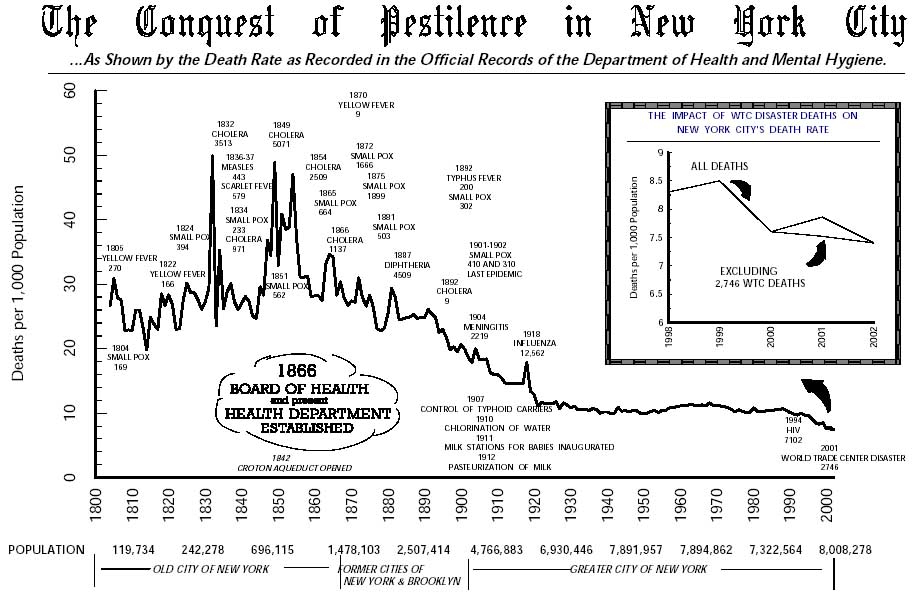
More recently (e.g. the last 150 or so years) social changes and technologies have allowed cities to move from places of pestilence to locations where you are more likely to be healthier, happier and live longer than your rural cousins.  These technologies are of course the lowly toilet, sewer system, asphalt (to reduce dust), internal combustion engine (to reduce things like horse dung) and clean water.  Parallel political structures needed to be created to provide these externalities* such as effective police forces, water works, street maintenance and an (ideally) non-corrupt overall administration to manage these services.

The Conquest of Pestilence in New York City; Stirling Behavioural Science Blog

The Conquest of Pestilence in New York City; Stirling Behavioural Science Blog

Slums as a Success Story

At this point, many people would point to the slums of Mumbai or Rio and suggest that the conditions there make cities a failure.  While Glaeser does not minimize the human suffering that does occur in quasi-legal no man’s land of slums, he also suggests that those living there are (on average) better off than their rural kin who they left behind.  Cities encourage innovation, reward hard work and there is a better chance to have access to medical care, clean water and schools for your children in a slum than in a rural province.

Once again, it is important to differentiate anecdotal, statistical and absolutes at this point.  For the young man who left a rural village in Brazil and died the next day in gang warfare in a Rio slum – cities would seem to be a bad deal.  But his tragedy has to be matched against the many others who became middle class through hard work, innovation or access to education.

Political Impact on Cities

Cities and political processes go hand in hand.  For example, the more democratic a country is, the more distributed its cities are likely to be; conversely, the more autocratic, the more likely that a single city will lord over other cities (the largest cities in dictatorships, … contain, on average 35 percent of the countries’ urban population versus 23 percent in stable democracies, p. 235).  Over the past 100+ years perhaps the greatest political influence on a city was the favouring of the automobile through the creation of highways and mortgage deductions for private ownership.

In the United States, the creation of the inter-state highway system (which was partially completed to support improved military transportation) has allowed for the creation of suburbs compounded by three other factors: road economics, tax policy and school funding.  The fundamental law of road congestion states that as roads are built, they are filled at nearly the same rate as their construction.  Thus more roads mean more traffic with only congestion pricing (a political hot potato if there ever was one) mitigating this effect.  Returning to the United States, a generous mortgage interest deduction further encouraged the purchase of the best available home a family could afford.  The localization of school boards and their funding meant that parents would also select a home where the good schools were.  The impact since the end of the WWII was the creation of a suburban sprawl and the gutting of inner-city communities.

The urban riots the United States has experienced can be partially traced to the flight of educated and leadership enabled citizens (white and black) away from the urban centers.  This was more than a lack of policing or social policy, this was as much the destruction of the social fabrics of the communities.  Akin this effect in the United States, Glaeser comments on how much safer the Mumbai slums are than the Rio equivalents despite the former being poorer.  Mumbai slums are better functioning social spaces and thus they provide their own safety nets and controls that are less likely to be found in the more transient Rio slums.

Creating Great Cities

Glaeser offers some direction on how to keep cities healthy, happy, lower environmental footprint and safe.  Firstly, allow cities to grow up.  This increases the density per square metre meaning that the same public-service is being optimized.  Green spaces are important to allow parents to raise their families and community safety must occur concurrently.  Community-based and adequate policing is part of the safety equation in addition to creating functioning social-spaces and communities.  Further to this, a community needs to have a say in the make-up of its local environment (bars, night clubs, daycares, etc.) but must not have a complete veto otherwise cities become balkanized into enclaves of Not in My BackYard.

Glaeser also strongly supports the consumption pricing of public goods.  Thus those driving in from the suburbs should be paying for this right or the developer constructing a high-rise tower should pay a sufficiently high enough fee to compensate the local community for this vertical-intrusion.  These are excellent economic principles that often falter in harsh light of political reality.  Nevertheless, at least they should be part of the discourse on what type of city we want to live in and have available to us.

Triumph of the City is a good read for anyone interested in the practical application economics and civil engineering to the messy realities of human communities.  The book is strongly skewed toward the United States context but Glaeser should be commended in bringing in numerous global examples to balance this bias out.  There are lots of juicy footnotes for those who want a deeper dive into the details.  Triumph of the City is a good book for any History/Economics/Civil Engineering-wonks out there.

(*) In economics, an externality is the cost or benefit that affects a party who did not choose to incur that cost or benefit [WIKIPEDIA].

Ribbon Cutting and Fire Rescues

Elected officials face the dual challenge of delivering good government while engaging in ribbon-cutting and crisis rescues. As public expectations rise, the complexities of governance increase, often leading to instability. Balancing immediate public appeasement with long-term effective management is crucial for maintaining a functioning civil service and a successful democracy.

Continue reading

Openheimer, Los Alamos and Summer Camp for Physicists

The Manhattan Project is well-known to even the most history illiterate.  The general story is that $2 Billion (1940’s) dollars were spent on secret facilities (including one in New Mexico, Los Alamos) to beat the Nazis to building the bomb.  A German surrender meant that the bomb was dropped on Japan ending the hostilities of the Second World War.

Traditional history is that the two bombs saved about 500,000 allied soldiers from death and dismemberment and many fold more Japanese military and civilians.  Revisionist history suggests that Japan was on the state of surrender anyway and the bombings (in particular the second one on Nagasaki) were unnecessary.

Los Alamos National Laboratory; “Jumbo”, a 200 ton container, was originally intended to be a part of the Trinity test, but was eliminated in final planning. Credit: Digital Photo Archive, Department of Energy (DOE), courtesy AIP Emilio Segrè Visual Archives.

Before the bombs, there was the effort to create the bombs.  In perfect hindsight, it is generally acknowledged that the Germans had no hope of ever developing a similar device. They had neither the treasure, time or talent to do so (on the talent front, their policies encouraged many of the central players such as Teller, a refuge from Hungary, to be available for the British and American efforts).  Nevertheless, in the dark days of the early 1940’s such knowledge was not available and the assumption was that London or New York could become a smoking pile of radioactive waste.  And thus the most American effort to the build the bomb.

Jennet Conant explores this effort in her book, “109 East Palace: Robert Oppenheimer and the Secret City of Los Alamos”.  Conant is an excellent story-teller and this is a great read for the history or leadership buff.  There are two central figures in the book.  The first, well-known to history, Dr. Robert Oppenheimer and the second largely unknown, Mrs. Dorothy McKibbin.  Dorothy was Los Alamos’ first employee and she manned the Santa Fe address that was the front for the laboratory many miles away.  More than simply a functionary, she was the sole contact for hundreds and then thousands of scientists, engineers, contractors and their families while they were in virtual lock down for nearly two years.  She located hard to find and rationed supplies, was a confidant, tireless worker and supplied her home for a number of marriages amongst the inhabitants Los Alamos (due to war-time secrecy only their first names appeared on the marriage license).  Down to earth, practical and a friend to all she was the perfect foil for Oppenheimer who was brilliant and could be arrogant and oblivious to social niceties.

The book rounds out an understanding of Oppenheimer.  For example, he was an avid outdoors man who would spent days trail riding or hiking in the desert.  This was an aspect of his personality that I would have not have guessed.  As the Director of Los Alamos, Oppenheimer had every reason to fail as a leader of the Los Alamos project because of his temperament and political past.  In the end, he commanded respect and loyalty amongst those who stayed and toiled – or hatred and loathing amongst those who left.  The leadership lessons focus on the establishment of a clear objective (building the bomb) and learning how to reach out to those who look to you for your leadership.

109 East Palace is a great companion read about the history of the project.  Ms. Conant brings a female perspective to the book telling the stories of wives, secretaries and families locked behind the secure gates and fences.  Conant does this without losing site of the technical and scientific achievement of the two years in Los Alamos.

In the end, a highly recommended book for those interest in history and leadership from a military, scientific, and female perspective.

Xeno Chronicles: How to become a Pig and live to Tell About It

The Xeno Chronicles: Dr. David H. Sachs and His Fantastic Plans for the Future of Medical Science by G. Wayne Miller

Xenotransplantation is the use of non-human organs in humans.  Follow this link if you want a good summary of the concept: http://en.wikipedia.org/wiki/Xenotransplantation

Still with me, then consider reading this book if you want a slightly more complete understanding of one researcher in Xenotransplantation, Dr. David Sachs.  Dr. Sachs is a very sympathetic character who has a dream of saving people through the use of animal organs.  In 2005, the publication of the book, Dr. Sachs has had some success with a genetically bred pig.  Unfortunately concurrent with this success is the loss of his major funding source.

The author does a good job of both portraying Dr. Sachs as a highly capable research, boss and a nice person in general.  Glimpses into Dr. Sachs early life are provided including a bout of polio.  On the other side, Wayne Miller presents a reasonably balanced portrayal of the pros, cons and moral minefield of using ‘Babe’ for our human replacement parts.

Babe the pig – not the same variety used for xenotransplantation but possibly just as cute (and tasty!). (image courtesy of virgin media)

Personally, I don’t have a problem with the concept of breeding animals for replacement human parts.  As long as the animals are treated well and have their life ended humanly, breeding (and the eating) Babe so that a person can life a fuller and longer life is okay with me.  Unfortunately (or fortunately for Babe), Xenotransplantation seems to be a long way off.

Although Baboons have survived a few months on pig hearts, every hurdle cleared seems to expose another challenge.  Thus, my larger problem with pursuing xenotransplantation is the diversion of resources away from other organ sources.

For example, an Opt-Out rather than an Opt-In system can increase the supply of donations.  In an Opt-Out system, everyone is assumed to be a donor unless they have expressly requested that they take their organs to the grave (Monty Python movie sketches notwithstanding).  A better registration of the intent to donate can mean that organs don’t go to waste when there was an intent to donate (e.g. Alberta’s new Donor Registry).

The challenge with a better human (or allotransplantation) is still rejection by the recipient.  Although this has improved over the decades with better matching and drugs, rejections is a threat looming over everyone saved with a new organ.  Xenotransplantation has a better supply of organs but the reasons for rejection.

Which leads me to my conclusions of xenotransplantation, this book and a lifetime of research conducted by Dr. Sachs.  I suspect that it may be time to give up on the idea of Babe as an organ donor.  It was a good idea and a good try but the effort remaining and the risk of cross species disease transmission does not make a good investment for society.  Instead, lets continue improving the supply of organs but also put our efforts into either machines that duplicate an organs function or growing  organs through cloning.

A machine that duplicates an organ function can be ever more precisely engineered.  Thus the clumsy artificial heart of the 1990’s can quickly become the science fiction of tomorrow.  Even better, lets grow or clone replacement organs and thus eliminate rejection and disease cross contamination.

So my thoughts on the idea of Xenotransplantation, Dr. Sachs and Miller’s book?  A good idea whose investigation was worthwhile and an okay book for those who can find it cheap or free.

Buying In – BzzAgents and Volunteer Marketers

Just finished the book, “Buying In: The Secret Dialogue Between What We Buy and Who We Are” by Rob Walker who writes a column for the New York Times Magazine: “Consumed“.  Being a cheap consumer, I purchased the book second hand from the excellent local used book store (SHAVA) that we have here in St. Albert.  As a result, the book is a bit stale published in 2008; well before the financial melt down and the resulting impact on consumption.

Nevertheless, Walker is an engaging writer who walks the reader through the world of consumption, brands and fashion.  For example, who knew that the Hello Kitty mouth was too hard to express in a cute way – so it was cut from the final design in 1974 (pp. 15-16).

Hello Kitty - sans cute mouth

Hello Kitty – sans cute mouth

Or that the Pabst Blue Ribbon (PBR) beer was purchased in 1985 by a Texas ‘beer-baron’ whose business plan was to slash costs and let the brand “decline profitably”. PBR used to be the blue-collar beer of the working man.  Now it is the markedted blue-collar beer made en masse.

While Hello Kitty and PBR are cute and taste okay (in that order), the interesting section in his book is on volunteer product evangelists or word of mouth marketers (p. 166).  These are volunteers who work for companies like BzzAgent who employ ‘volunteers’ to talk up products.  The volunteers button-hole friends, neighbours and unsuspecting would-be consumers with encouragements to buy sausages, perfume or read particular books.  They are encouraged to post positive reviews and write glowing praise of the particular product that is being promoted.

Some of the volunteers spend as much as 10 hours a week doing the promotion, writing reports and networking with other volunteers.  This is a part-time job working for a marketing company, promoting products – all done pro bono.  Walker provides an example of one word of mouth marketer:

Gabriella and the rest of the [BzzAgent] sausage agents are not paid flunkies trying to maniplate Main Street Americans; they are Main Street Americans…. … and she gets no remuneration.  She and her many fellow agents had essentially volunteered to create “buzz” about …. dozens of … products, from books to shoes to beer to perfume.  By 2006, BzzAgent claimed to have more than 125,000 volunteer agents in its network.” (p. 168)

While these volunteers earn points for prizes – many do not cash in the points.  So what motivates them?  One BzzAgent agent Ginger explained her willingness to volunteer for the following reasons:

  • It was a chance to get products before their release (and be an insider)
  • BzzAgent gives her something to talk and opinion about with other people
  • She believes she is helping people – by promoting a specific product.

To be fair BzzAgent’s code of conduct includes an expectation that:

BzzAgents always tell others they are part of a word-of-mouth program.  Be proud to be a BzzAgent. When Bzzing others, you must let them know that you’re involved with BzzAgent and tell them what you received as part of the campaign. If you genuinely like something (or even if you don’t), it’s your open, honest opinion that counts.

Code of conduct notwithstanding, somehow it feels like BzzAgents are on the wrong side of an invisible line.  Certainly they are not boiler-room fraudsters trying to hustle little old ladies out of their life savings – but still there is a part of me that is a bit queasy about the whole word-of-mouth marketing model.

Perhaps it is because I am a ‘free-lance’ word of mouth marketer.  I promote businesses that have given me good services or products and I do so because I believe that I am being helpful.   However, I do so on products and services of my own choosing and without having to report back to the business (or an intermediary such as BzzAgent) of my efforts to date.  As well, when in the course of a normal conversation, how exactly do you interject that you are now been sponsored by the ACME corporation?  I envision a conversation like:

  • Frank’s Friend: Boy it sure hot today!
  • Frank: Sure is… oh, by the way, this part of conversation is brought to you byBzzAgent and Pabst Blue Ribbon beer or PBR.
    • Boy this PBR is sure refreshing, goes down smooth and is cheap too.  The beer of hipsters and rappers, PBR is the only beer for me. 
  • Frank: We now return to our regular conversation already in progress.
  • Frank’s Friend: Huh?  Are you okay?  I think you need to get out of the sun and stop drinking so much of the PBR swill.

Myself, I am happy to stay on this side of that invisible line and continue to promote/malign in an objective manner good/bad products and services.  Nevertheless, I would love to hear your comments – perhaps over an ice-cold and refreshing PBR, the official beer of word of mouth marketers….

Where Public Health Stops and the Nanny State Begins

Last week I had the pleasure of hearing Dr. Talbot speak.  If you don’t know who he is but you have heard of the current measles outbreak or past-pandemics, then you know of his and his office’s work. In addition, if you get a chance to hear him speak (and hopefully not telling you that there is a quarantine on your house), be sure that you hear what he has to say.

Firstly he is an engaging and down to earth speaker who has a knack of being able to explain the complex via the simple metaphor.  Secondly he has excellent perspectives on how public health can be cheap yet effective.  Finally he has an excellent sense of the history of public health and a sense of humor.  He can tell you about the cholera outbreaks of yester-year to the current measles blip with a wry context.

So while I would encourage you to hear Dr. Talbot speak, listen as a private-citizen looking to protect your own right of choice in a free society.  Hear what he has to say on public health but ask where the public good stops and the Nanny State begins.  Here are some examples, one past and some future.  The past example is the public health battle against public smoking.  I will admit that I have had the very occasional good cigar but otherwise have never caught the smoking bug.  Thus, over the past ten years, I was ambivalent and ultimately thankful when smoking was banned in places like bars and restaurants.  In my view,assuming you have read the warnings on a cigarette package, and you are not polluting my space or kids – it was your choice to start, continue or stop smoking.  In other words, banning smoking in public places is a reasonable public health compromise of personal choice versus public good.

Fast forward now into a time when sugary drinks are perhaps the new smoking campaign.  Not only will we not be able to super-size our mega-drinks while ordering a big Muck, they pop is banned outright as a public health measure.  Because I am not a big pop drinker, perhaps I will continue to watch this change with more ambivalence.

But what about the next step beyond smokes and a glass of pop.  What happens when public health measures become so intrusive that there is a backlash against them – and good is thrown out with the bad.  Perhaps we are seeing this already with the local measles outbreak.  A virtually preventable disease making  a come back because some parents have chosen not to vaccinate their children.

In other words, public health measures which effectively reduce our choice or make decisions for us (smoking, sugary drinks) may lead to public health challenges because people are tired of having choice taken away from them.

This situation can be described in the question of where exactly does public health stop and an intrusive nanny state in the guise of public health kick in?  I don’t have an answer but it is an excellent question that I will ask Dr. Talbot the next time I hear him speak.