Day 2: Power, Cyber-Security and Renewables

This is the second list of potential disruptive factors that could influence the Canadian Public Service over the next decade or so.  See the previous blog for the first set of three and Seven Days of Disruption blog for the entire set.  These are in support of November 22, 2017 FMI Conference – Disruptive Writers.

  • Changing Nature of Power (2015)
  • Cyber Insecurity (2015)
  • Dawning of a new urban transportation age and the Canadian City (2017 and editor)

Changing Nature of Power (2015)

Adapted from A.T. Kearney 2015: In today’s world, power is increasingly fleeting and diffuse.  It is disseminated across individuals empowered by new technologies such as search engines and social media; to lower levels of government, including cities; and to start-ups and user-driven networked organizations. The rise of the global middle class is leading to greater individualism and expectations for service from their governments and from businesses, with consumers having never had a broader freedom of choice. Global trust in most institutions reached an all-time low in 2015, with governments continuing to be the least-trusted institution.

Editor note: So What?  The answer is that trust is foundation of a society and an economy.  It profoundly reduces the transaction cost in both.  Public institutions support this trust by enforcing social norms. In a strange twist, public institutions are sometimes powerless at the hands of a small but vocal group of individuals.

For example, an August 2017 discussion on free speech at Ryerson University was cancelled because the University was concerned about safety and security.  Described as domestic terrorism by one of the panelists, this is an example of public institution (Ryerson) self-censuring thought and discussion with a resulting degradation of its own power and trust.  While the individuals involved may congratulate themselves on forcing their view points onto an entire institution, they should also recognize that they are sharing a common heritage with the black, brown or red shirts who dominated politics a century ago.

Cyber Insecurity (2015)

Adapted from A.T. Kearney 2015:While the upside of the Internet is enormous, cyber threats continue to multiply. Estimates put global cyber crime losses at somewhere between $375 billion and $575 billion annually.  All connected devices and systems are vulnerable to attack. Computer systems, for example, are vulnerable to ransomware. The growing IoT also lacks strong security systems and is highly vulnerable to data theft.  To make matters more complex, the cyber arena is a growing domain of warfare between countries, in which businesses can be caught in the crossfire. The “Darknet”—parts of the “Deep Web” that are not discoverable by traditional search engines—remains a serious criminal threat, especially with the rise of crypto-currencies. It is cloaked with encryption software that provides anonymity to users. The Darknet is used as a source of cyber attacks, as well as a place to buy and sell ransomware and other cyber weapons. Another business risk of the Darknet is that it provides a marketplace for stolen data collected through cyber attacks, augmenting hackers’ motivation to continue conducting such attacks.

Editor note: Governments see online services as a way to provide better government for fewer resources.  The Singapore, Scandinavia and the United Kingdom are acknowledged leaders in this effort although the Canada Revenue Agency has also made great strides in allowing for a digital experience.  Nevertheless, governments have a number of challenges including the Facebook-effect, the Shiny-bauble problem and resource asymmetry.

Facebook Effect – You are the Product

The Facebook-effect is the problem of comparing government services to a for profit service such as Facebook.  If Facebook can provide service xyz or make its offerings free, why can’t a government?  There are of course a number of answers to this.  Firstly Facebook is not constrained by the same legal, moral and democratic frameworks.  Facebook has an entirely different revenue model.  For social media, the user is the product.  Thus your likes, shares and contributions builds up a profile of you as a person which can then be monetized.  For governments such monetization of a citizen would be outrageous.  Finally, Facebook can fail while governments are expected to be enduring.  If Facebook ceased to exist tomorrow it would be inconvenient but a new social media product would take its place (anyone still using MySpace?).

The Shiny-Bauble Problem

Governments like to implement new things.  Ribbon cutting and shovel turning is good press and leads to the primary objective of any government – staying in power.  As a result, governments get distracted by the Shiny-Bauble which have a short-term effect or solution that has little enduring value and may cause long-term harm to a society.  The worst thing about Shiny-Baubles is that they may become entrenched in a society by a small group who benefit from the government largess.  In other words, the only thing worst than a Shiny-Bauble is trying to turn one-off.

Resource Asymmetry

Governments often have fewer and less enabled resources to delivery digital services or fight cyber-threats than the legitimate and illegitimate competitors.  The above Facebook discussion is one aspect of this resource asymmetry and consuming valuable government resources pursuing a Shiny-Bauble is another.  A darker example of asymmetry is that the bad guys only need to look for and exploit a single weakness in a government’s cyber environment.  At the same time, a government must fight all threats while trying to provide services.

Dawning of a new urban transportation age and age of renewables (2017 and editor)

Adapted from A.T. Kearney 2015: The global urban population has risen steadily over the past two decades. According to the United Nations (UN), there were about 2.9 billion urbanites in 2000, but that number has increased to 4.1 billion and will hit 4.5 billion in 2022. The number of megacities, defined as cities with 10 million or more inhabitants, rose from just 17 in 2000 to 29 in 2015, and the total is projected to rise to 36 by 2025. Hyper-urbanization is heightening congestion levels in cities around the world. The age of the automobile may be ending as cities adopt innovative new technologies and use more traditional mass and individual transit methods to enable smarter and more sustainable urban transportation and growth.

(Editor) Public transit and electric vehicles are two ways that urbanization will change the face of a city but tele-commuting and promoting walk/bike-able cities are another.  This raises a challenge for Canadians as much of our housing stock has been built since the mid-20th century and the economics and logistics for all of these mitigating solutions will require significant government investment and coordination.  It will also require a change in cultural norms and expectations as owing a home has become central to financial and personal-security well-being.

Day 1: Climate, Biotech and Canadian Competitiveness

What are some of the larger potential disruptive factors that could influence the Canadian Public Service over the next decade or less.  The following three are the first in a list that will be used at the November 22, 2017 FMI Conference – Disruptive Writers.

  • Seven Days of Disruption (Initial Blog).
  • Accelerating Global Climate Change and the cost to mitigate (2015 and editor)
  • Biotechnology: Frankenstein, Super-bugs and Super-cures (adapted from 2016 and editor)
  • Canadian Competitiveness and Productivity (editor)

Accelerating Global Climate Change and the Cost to Mitigate

Adapted from A.T. Kearney 2015: Food production, rising sea levels, increased range of tropical diseases and impacts to fragile environments such as the arctic and northern forests are some of the negative impacts identified.  At the same time, Canada could be a net beneficiary as more of its land mass becomes suitable for agriculture and lower cost for exploration of mineral wealth in the arctic.  These are tenuous gains as compared to social and mass population upheavals however.

Editor note: in many ways the past 200+ years of using fossil fuels can be compared to a young person inheriting a vast fortune from an unknown dead relative.  The changes have been both negative and positive.

On the positive side, there are billions of people alive today or who have lived in the past two centuries that would not have lived without the exploitation of fossil fuels.  Fossil fuels have given us a standard of living in which even the poorest Canadian is living better than many past kings or queens.  Hydrocarbons deliver clean water, warm homes, take away sewage, pave our streets, move food to our stores, fix nitrogen out of the air to grow the food and give us miracle materials such as plastics.

However, like a young adult waking up from a massive party we are also noticing that the trust fund is running low.  As well, 200+ years of living with fossil fuels has directly or indirectly killed many of our fellow species, polluted our homes.  The hunt for the fuels have led to corruption and creating vast fortunes in societies that have exported extremism and intolerance of things like women’s rights.

The cost to leave the fossil fuel era is considerable and may not occur in our lifetime.  The reality is that the engineering and technologies to replace an energy dense and convenient storage medium such as gasoline is considerable.  Canada has committed to shutter its coal power plants.  In 2014 this represented approximately 10% of the nation’s total generation nearly all in Western Canada [1].  Assuming these plants are closed by the target date of 2030, 63.6 terrawatt hours of capacity will need to be replaced [2].  Globally, Canada’s coal generation represents 0.67% of the total world generation capacity [3].  Thus the cost of leaving fossil fuels in the ground are not only direct but indirect as we place ourselves at a competitive disadvantage despite being a global powerhouse in energy reserves.

Biotechnology

Adapted from A.T. Kearney 2016: Just four years after its invention, “copy-and-paste” biotechnology is bending the cost and timeline curves for major scientific breakthroughs. CRISPR-Cas9—which stands for “clustered, regularly interspaced short palindromic repeats” and “CRISPR-associated protein number nine”—was discovered in 2012. This biotechnology has the ability to delete, repair, or replace genes, making it a function for genetic manipulation that will allow researchers to do three things more cheaply and effectively than ever before: alter human genetic code, cure diseases, and even create new lifeforms.   Its applications will have far-reaching impacts on a multitude of industries, altering business models, regulatory environments, and consumer demands and preferences worldwide.

Editor’s Note: Bio-technology is one of the things that makes us human even if the technology part has advanced considerably.  10,000 years ago the methods would have included burning forests to plant crops or encourage grazing animals; selecting grains such as wheat, rye or rice; or domesticating the dog, horse or cow.

More recently state sponsored food research was central to of the green revolution of the late 20th century.  Genetically modified food has continued this revolution although with a sense of unease.  Bio-technology promises designer cures for diseases and an improved standard of living for humanity.  The shadow includes Frankenfoods, designer babies and other nightmares from science fiction.  Regulation and a stable civil society is one way to control this.  Another method is to ensure that the work is done in a culture of openness and transparency – something perhaps more difficult if the research leaves Western countries and is taken up in repressive regimes or nations lacking a history of civil discussion.

Canadian Competitiveness

Adapted from the Conference Board of Canada: Canada’s standing on the 2017 Global Competitive Index as issued by World Economic Forum improved one place to 14th.  Switzerland ranks first, followed by the United States, Singapore, the Netherlands, and Germany.  Taxation and government regulation impeded competitiveness while a good K-12 and post-secondary education systems provided an offset.  Canada benefits from efficient labour markets and a sound financial and securities systems.  Canada lacks consistent investment in research and development, has degrading public infrastructure, poor coordination between universities and business and an over-reliance on natural resources.

Editors Note: This subject was discussed at the September 21, 2016 FMI Edmonton Chapter event Fostering Innovation in the Public Service When Money is Tight.

[1] Adapted from Canada Coal Profile, Figure 6 and Table 1, accessed 2017-11-13; https://www.iea.org/ciab/papers/Canada.pdf.
[2] ibid Power generation (gross) in TWh in 2014.
[3] Key World Energy Statistics, Electricity Generation by source, accessed 2017-11-13;  http://www.iea.org/publications/freepublications/publication/KeyWorld2017.pdf

Seven Days of Disruption

On November 22, 2017, the Edmonton Chapter of the Financial Management Institute is running an event entitled ‘Disruptive Writers‘.  In addition to hearing 3 great speakers discuss their books on either future disruptions or managing change, we will be playing a game called ‘Pin the Tale on the Disruption‘.  Sort of a mini-Delphi of what participants at the conference think will be the biggest challenge to the Canadian Public Service between now and …. ohhhh, say…. 2025 (e.g. about 7 years hence).

The Source of Disruption

There is a variety of sources for the disruptions but they are primarily based on the excellent work of the A.T. Kearney who have produced 3 Global Trend documents (available as follows):

It’s tough to make predictions, especially about the future (Yogi Berra)

A word of caution about the difficulty of making predictions.  Inevitably something better or worse will have muscled all of the excellent possible futures out of the picture.  In addition, Black Swans and the unpredictable are a near certainty.  So, to my future self, I profusely apologize/acknowledge for being so absolutely wrong/right in naming the following future disruptions.

A Laundry List of Disruption (in alphabetical order)

  1. Accelerating Global Climate Change and the cost to mitigate (2015 and editor)
  2. Biotechnology: Frankenstein, Super-bugs and Super-cures (adapted from 2016 and editor)
  3. Canadian Competitiveness and Productivity (editor)
  4. Changing Nature of Power (2015)
  5. Cyber Insecurity (2015)
  6. Dawning of a new urban transportation age and the Canadian City (2017 and editor)
  7. Depopulation Waves (2015)
  8. Evolving Artificial Intelligence (2015)
  9. Geopolitical Realignment and Continued Global Violent Extremism (2015)
  10. Growing debt overhang (2017)
  11. Immigration and Changes to the Canadian Values and Characters (editor)
  12. Indigenous Power (editor)
  13. Islandization” of the global economy (2017), NAFTA Negotiations and the rise of protectionism (editor)
  14. IT Revolution 2.0 and the Rise of the Machines (adapted from 2015)
  15. Post Consumerism (adapted from 2016)
  16. Quebec and Regional Tensions (editor)
  17. Resource and Commodity Supply, Demand and Price (adapted from 2015)
  18. Rising storm of populism; Canada and Cultural War in the Age of Trump and the Progressives (adapted from 2016 and editor)

Must Read Books

In 2015 there were a little more than 17,000 Business/Economics books published in the United States out of a total of 256,000 [1].  Assuming business and economic books were evenly divided between them – that is 8,500 for each category.

You could have kept up with all the new books published… assuming you read one per hour and did not bother sleeping for that year!  In other words, there are a lot of books to read, where to start?

Trust Me – Call a Friend

Most people accept recommendations from trusted sources such as a friend or colleague.  Others watch for suggestions in trusted magazines or online blogs.  Others trust the book seller (e.g. Chapters, Audreys or Amazon) for their recommendation.

The common thread in all of the above is ‘Trust’.  We trust our network (immediate or otherwise) to filter out and find the few gems worth reading.

Disruptive Writers and Crowd Sourcing Must Reads

This brings me to an interesting exercise at the next FMI – Edmonton Chapter Event, ‘Must-Reads’.  We are asking attendees, speakers and individual in the know for ‘about 3’ book recommendations. In effect we are crowd sourcing how to spend our precious reading time.

The results so far? 23+ recommendations with more coming in all of the time.  If you are interested in what these reads are, be sure to download the pre-conference notes.  Even better, join us in Edmonton on November 22, 2017 to learn more about these Must Reads!

Some Key Links:

  1. The Hot and Cold Book Categories of 2015, Publishers Weekly.  Access 2017-10-30.


CPA Awards & the Public Service

I find myself on the Chartered Professional Accountants Awards Nomination committee. We are responsible for identifying individuals who are eligible to receive one of the following awards:

Continue reading

Kettle Valley: Chute Lake – What a Road!

This is the last of 3 blogs concerning my 2017 riding of the Kettle Valley. The good intentions were to hub and spoke out of Penticton and complete three rides: 1) Osoyoos North to Penticton; 2) Skaha Lake 3) Chute Lake to Penticton.

What Road!

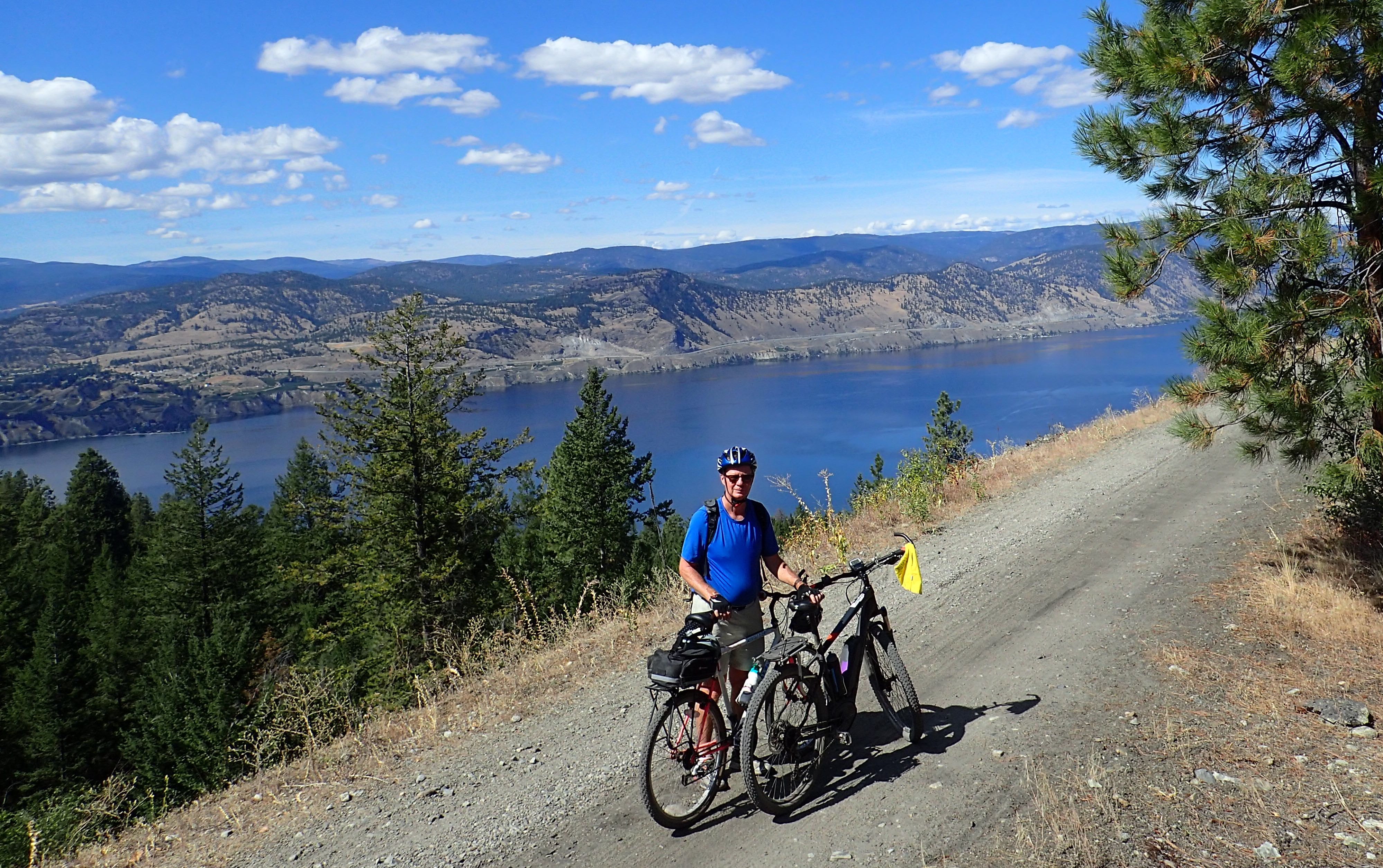
The road up to Chute Lake was impressive. At times a 12% grade with numerous switch backs on a sandy gravel surface. It was challenging enough in dry weather I could only imagine the climb after a recent rain or snow fall.  Slick as snot comes to mind (to use a technical term).

The road deposits you at the Chute Lake Resort and the lake itself. The KVR passes the lake from a point further east and our original put-in, Myra Lake. Had we started from Myra, the distance would have been 80KM.  A bit out of reach for a first ride of the area so Chute Lake was a reasonable compromise.

Mileage Signs en route.

Sand Bogs and a Closed Tunnel

The first 5KM or so of the ride was mush. Mush in this context means sandy soil that quickly absorbed one’s tires and made it nearly impossible to ride. In some places a raised shoulder provided enough terra firma to allow for some speed but often this effort was absorbed with a return to the mushy middle of the trail. Lower air pressure likely could have compensated and I suspect a good fat bike tire would have glided over this section of trail with barely a whimper or note of the mush underneath.

After this initial section, the trail began to harden to a more uniform gravel bed that was generally fine to ride on.  Given the altitude gained on the road up to the put-in, vistas were available aplenty. One portion of the trail that was closed was a U-shaped Adra tunnel.

Currently barricaded, the tunnel is about 500M long and takes a north/south orientated track to an east/west exit/entrance. Appeals for donations are made for the tunnel’s restoration which would be great. In the mean time a steep descent provides a cut off for the tunnel. A fun ride down, it would be a hard ride/push up! Coming from descent side of the tunnel, the temperature appreciably drops at 10C in the gloom of its entrance.

In front of the closed Adra tunnel.

Ride Into Penticton

From the tunnel, the ride is a gentle descent past numerous historical markers including a number of rock ovens used to bake bread during the KVR’s construction. Other markers include the foundation for a long-since dismantled water tower, a larger Ponderosa Pine and things of that ilk.

One of the great vistas with Summer Land across Okanagan Lake.

Conclusion

Our transport picked us up still high above Penticton. The trail however continues down into the city along the KVR route and as well along a city constructed trail. Finding the trail required a small bit of route finding as one section would end and the next would start-up to half a block away. A disappeared trail general meant a scan up and down the road to see where the city put the next piece.

Overall, this is a great section of trail. The ride from Myra Lake to Penticton is very doable on a good mountain/fat bike. Likely this would be an all day affair particularly with a car shuttle. Given the remoteness of the initial section, an available support vehicle would be a strongly desirable additional feature. In other words, Penticton KVR – I will be back!

Kettle Valley: Skaha Lake Loop – Ice Cream Detour

This is the second of a set of 3 blogs concerning my 2017 riding of the Kettle Valley. The good intentions were to hub and spoke out of Penticton and complete three rides: 1) Osoyoos North to Penticton; 2) Skaha Lake 3) Chute Lake to Penticton.

Skaha – Consolation Prize

Unfortunately my partner in riding had an unanticipated work commitment and the planned ride could not occur. Nevertheless, the ride we did was a perfect little putz with a too large ice cream in the middle.

Skaha Lake is just south of Penticton and like most of Okanagan lakes is narrow and long. Smaller than most lakes, it is 11.8km long and book ended by Penticton to the North and Okanagan Falls to the south. This ride took us from our motel at the north end of Skaha south along the west side of the lake to Okanagan Falls.

Although the trail was empty when I rode it the previously day, on this day there were about a dozen cyclists and walkers using the trail. The trail itself deposits you at the beach in Okanagan Falls and from this location the logical thing is to look for ice cream.

Vista Skaha Lake from the west side.

This is a Children’s Cone?

On the south side of the town is an ice cream institution, Tickleberries. A combination of ice cream gift and junk shop, they are known for their generous portions so I thought I would be smart by ordering a childrens cone. Apparently in the Okanagan, children are capable of eating two fist size scopes of ice cream! Either they are very tough or have a morbid obesity problem.

Return Along the East Side

Like most large lakes in British Columbia, there is a distinct East and West side (mostly because the mountain ranges generally in BC run North/South). Our return was along the East road and generally it was uneventful and occasionally pulled the user up into a mid-level vista of the lake. Good asphalt and a reasonable shoulder. We took a short detour back into Penticton to find a cold beer and then rode out to the hotel.

Conclusion

A nice albeit short ride of about 30km with moderate undulations in climbs and descents. Suitable for an older child reasonably comfortable on a bike. This could be a tune up and a first day ride if just arriving in the area. The one factor is the amount of fine grit and sand on the west side which tends to cover the bike and running gear. Like other trails in the KVR, a good chain cleaner is a must post ride!

One of the many historical and natural sites along the route.

Kettle Valley Osoyoos to Penticton – NOT

This is the first of a set of 3 blogs concerning my 2017 riding of the Kettle Valley. The good intentions were to hub and spoke out of Penticton and complete three rides: 1) Osoyoos North to Penticton; 2) Skaha Lake 3) Chute Lake to Penticton.

These rides were based on the trail guide: Cycling the Kettle Valley Railway, by Dan Langford.  Generally a well written and descriptive book, in this section alas it failed miserably.  Not to put too fine of a point on it but there is NOT a contiguous trail North from Osoyoos to Penticton.  The trail guide is not the only source that suggests that there is such a route, the provincial maps also clearly show such a trail.  Certainly poking around north Osoyoos failed to yield much evidence.  However, if you don’t mind a bit of highway riding and some flat and boring trails, you can get North to Penticton.

Note: this is a potential source of future reference, Trails BC.

North of the 49th

We started our ride at the border crossing just south of Osoyoos.  Still in Canadian territory, the ride went north along Highwya 97 to Osoyoos town limits.  From the park in the town, a trail winds it way North until private land and signs indicating no trespassing stop you at this point.  Apparently the land on which this spur of the railway was sold in the 1970’s and there is no longer a legitmate public access route.  As well, there is some hostility amongst landowners against a trail being created due to concerns of vandalism, etc.

Back to Highway 97

From the end of the trail, we re-climbed out of the valley to highway 97.  While the road is ‘okay’ (reasonable shoulder, moderate to heavy traffic), it certainly is not ideal. In the end we cut east again along Road 22.  Mentioned a few times, this road was also ‘okay’.  It had its share of undulations and the hill climbs gave a moderate cardio work out.  The alternative was to ride along the river/irrigation canal that runs from Skaha Lake to the North and Osoyoos Lake to the south.

Road 22 to Oliver

Road 22 eventually descends into the town of Oliver where we had a spot of lunch in the park.  From there, the trail along the river continues on until it intersects Highway 97.  Once again, the maps suggest that it continues west of the highway but we could find no sign of the trail.  Instead the route was along highway 97 to Okanagan Falls.  From here there is an excellent trail on the west side of Skaha lake that will take you into south Penticton.  Along this route I had the following black bear experience:

On a remote section a black bear Cub popped onto the trail. The problem with a bear club 100m ahead of you is where is it’s the mother. Fortunately she popped up beside the cub. She took a look at me and decided I was not worth the bother and ambled off to the other side of the trail with cub on tow. At this point, 15 seconds later I was glad I was uninteresting… Alas no photo but at least I got to tell the tale!

Conclusion

It might be interesting to go back and try to find a route from Osoyoos to Penticton… okay, not fantastically high on the priority list of trips to do in the time remaining here on earth, but if circumstandes allow for it, interesting nevertheless.

Starting on one of the intermittent sections of the Osoyoos to Penticton KVR.

Driving MS Daisy 2018

A Little Context Please

Canada has the highest rate of multiple sclerosis (MS) in the world, with an estimated 1 in 340 Canadians living with the disease. While it is most often diagnosed in young adults aged 15 to 40, younger children and older adults are also diagnosed with the disease (source, MS Society).  Each June the MS Society of Alberta and the NWT runs the Leduc to Camrose ride over two days and about 150km.

Year round bikes are a key transportation means.
Continue reading