EBTC – 2016-03-01: 6:00pm – Just for the Hill of It!

This is the third snowshoe event which has had a bit of a spotty record what with the warm weather.  The weather forecast is great -2C with light  winds.

The Objective

  • Practice ascending and descending slopes with snowshoes and poles.  Links and references:
  • Practice will include
    • Assessing the fall line of a hill.
    • Side stepping
    • V-Step/herringbone climb
    • Slope Traverse
    • Toe-Kick
    • Descent with and without poles

Where are We Going and How to Get Back

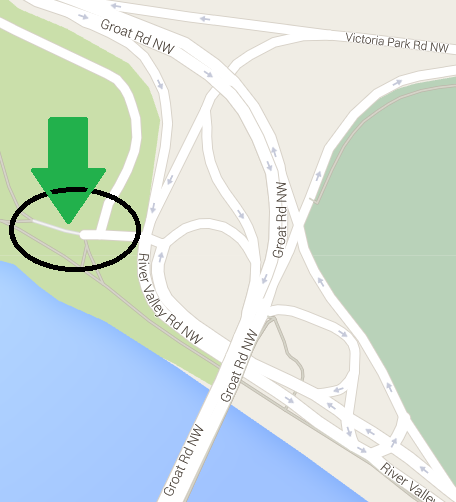
Government House Park - parking lot. NW Corner of Grout and River.

Government House Park – parking lot. NW Corner of Grout and River.

  • Meet at Government House Park parking lot.  This park is in the NW Corner of Grout Road and the North Saskatchewan River.  Exit off the western terminus of River Valley Road.
  • We will shoe west along MacKinnon Ravine taking advantage of the small slopes and valleys.
  • As time permits, we will try to get as far west as 142nd Street.
  • Advanced snowshoers can optionally attempt to summit 149th Street and return to the parking lot prior to the main group finishing its route.

What to Take

  • Snowshoes (duh!) and poles (optional).
  • Clothing appropriate to the weather.  Noting that I tend to run hot, I am plan to wear/bring:
    • Hiking boots
    • Lightly insulated shell pants
    • Long sleeve cycling jersey and a cycling shell (shell is shelved fairly quickly)
    • Fleece neck warmer
    • Cycling beanie and/or a baseball cap
    • Full fingered cycling gloves
  • Headlamp (generally these will be off but just in case we need them).
  • Backpack to carry/stow clothing
  • 0.5 – 1.0 litre of water

Books, Where to Buy and Other Resources:

EBTC – SCRUBBED!

SCRUBBED!  – For Safety Reasons, this session has been cancelled

This is the third of about twelve snowshoe events I will be running for EBTC.  The weather forecast is VERY WARM, -1C with light winds.

The Objective

  • Snowshoeing on a variety of terrains including through the trees.
  • How did the snowshoer crossed the road? (Answer, carefully).
  • Enjoy the legislature lights before they are taken down; bring your camera!

Where are We Going and How to Get Back

  • Meet at the skate shack at the SOUTH end of the legislature grounds (look for an ATCO trailer topped by a giant snowman); if you need an address try: 9515 – 107th Street Edmonton.
  • We will remain on the south lawns of the legislature grounds, don’t worry though – lots of adventure awaits!

South Legislature Grounds

South Legislature Grounds

What to Take

  • Snowshoes (duh!) and poles (optional).
  • Clothing appropriate to the weather.  Noting that I tend to run hot, I am plan to wear/bring:
    • Hiking boots
    • Lightly insulated shell pants
    • Long sleeve cycling jersey and a cycling shell (shell is shelved fairly quickly)
    • Fleece neck warmer
    • Cycling beanie and/or a baseball cap
    • Full fingered cycling gloves
  • Headlamp (generally these will be off but just in case we need them).
  • Backpack to carry/stow clothing
  • 0.5 – 1.0 litre of water

Books, Where to Buy and Other Resources:

Write as a Team Sport: Antifragile Strategic Planning

I have been able to call upon friends and colleagues twice to help me craft articles.  In both cases IAEA Property, Plant and Equipment Framework and LATE the group provided me with excellent advice.

A huge note of thanks (and a libation or coffee on me next time I see you) to the following individuals who provided ‘friendly-peer-review’.  As in the last go round, the result was a much better article.  The article itself can be accessed through my “Antifragile Strategic Planning: director’s cut” or directly from the FMI website: January 2016.

Thank you for the Use of Your Brain

Of course no good deed ever goes unpunished and to that end, the following are the folks who have helped me with the friendly-peer-review.  Hopefully I can return the favor in the future.  Also, if you are on the list and are logging this as professional development, feel free to refer to this post and notice below.

Person

Organization

Anne-Marie A.Alberta Bone and Joint Health Institute 
Pam Q.Athabasca University
Stacey D.Government of Alberta
Shakeeb S.Government of Alberta
Peter N.Retired

To whom it may concern, the above individuals were asked to perform a friendly-peer review of an article intended to be published in the Financial Management Institute of Canada journal, FMI*IGF Journal. The estimated time to perform this review was between 2 to 3 hours completed in early December, 2015. All of the above individuals demonstrated a firm grasp of the subject matter and helped to create-net-new original thought and critique through this peer-review which will be reflected in the final article. 

The above activity meets the definition of Charter Professional Accountant – Alberta’s verifiable continuous professional development.  Evidence for this include this web page attesting to the involvement as well as the emails and responses provided to myself.  I welcome contact if further confirmation is required.

EBTC – 2016-01-19 – Counter Revolutionary Snow Shoeing

This is the second of about twelve snowshoe events I will be running for EBTC.  The weather forecast is great -11C with light winds.

The Objective

  • Fumble and stumble through setting up potentially new equipment for the first time.
  • For absolute newbies, get used to the experience of walking on big aluminium boots.
  • Evaluate how much/little clothing is needed relative to the weather and physical exertion.
  • Practice basic hill skills including traversing a slope.

Where are We Going and How to Get Back

  • Victoria Park, meet in the parking lot for a 6:15pm start.
  • We will be walking on the skate part of the groomed cross-country ski trails in addition to going off trail a bit.

What to Take

  • Snowshoes (duh!) and poles (optional).
  • Clothing appropriate to the weather.  Noting that I tend to run hot, I am plan to wear/bring:
    • Hiking boots
    • Lightly insulated shell pants
    • Long sleeve cycling jersey and a cycling shell (shell is shelved fairly quickly)
    • Fleece neck warmer
    • Cycling beanie and/or a baseball cap
    • Full fingered cycling gloves
  • Headlamp (generally these will be off but just in case we need them).
  • Backpack to carry/stow clothing
  • 0.5 – 1.0 litre of water

Books, Where to Buy and Other Resources:

EBTC – January 12 Snowshoe – Golfing with Big Feet

This is the first of about twelve snowshoe events I will be running for EBTC.  Being the first, this one will ease the group (and more importantly me!) in the evening program. The weather forecast is great -3C with moderate WSW winds.

Off the snow track

Off the snow track – St. Albert, December, 2012

The Objective

Where are We Going and How to Get Back

  • Meet at the Victoria Park Oval parking lot (off River Valley Road, first right west of the Glenora Club) and be ready to go by 6:15pm on January 12, 2016.
  • Plan is to head west of the Skate Shack and pick up the X-Ski trails.  From there we will loop through Victoria Park Golf Course on the skate portion of the trail.  Go east as far as the Glenora club and then take the North trail back.  Based on the time, retrace our steps or short cut back to the skate shack.

What to Take

  • Snowshoes (duh!) and fixed length poles
  • Clothing appropriate to the weather.  Noting that I tend to run hot, I am plan to wear/bring:
    • Hiking boots
    • Lightly insulated shell pants
    • Long sleeve cycling jersey and a cycling shell (shell is shelved fairly quickly)
    • Fleece neck warmer
    • Cycling beanie and/or a baseball cap
    • Full fingered cycling gloves
  • Headlamp (generally these will be off but just in case we need them).
  • Backpack to carry/stow clothing
  • 600ml’ish of water

The Result Was…

  • Completed after the event for future learnings.

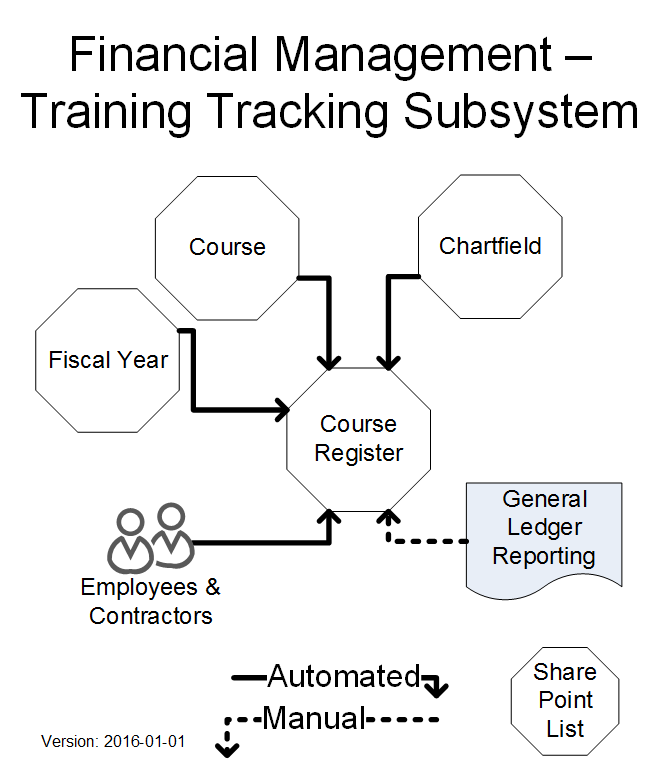
Staff Development – Tracking via SharePoint

In my ongoing effort to both remember what the heck I have done and to share good ‘pracademic’ ideas, I present a method to track staff training.  Hopefully you can use/adapt what you find here and hopefully I can remember how I built it in case I need to do it again in the future!

SharePoint list topology for a training tracking system.
Continue reading

Packing for Mars – Bring a Strong Stomach

Are you looking for that perfect Christmas present for someone who likes a combination of history, technology, science and is not too squeamish?  If that case, can I recommend that you give him or her some space… err, history?

Mercury Capsule cross section courtesy of nasa.gov.

Mercury Capsule cross section courtesy of nasa.gov.

I love Roach’s style and ‘Packing For Mars: The Curious Science Of Life In The Void’ fills the vacuum left by other science writers.  In it, Roach discusses the most daunting aspects of manned space travel.  These are not escape velocity, not heat shielding or hostile aliens.  The most difficult aspects are things like what do you eat, how do you shit, carnal needs and keep morale up in an environment of bland food, fecal bags, abstinence.

Junior High Questions Answered by Government Researchers

While such challenges may evoke junior high’esque guffaws these are also real problems particularly as space travel increases in duration and may eventually lead to colonization if not more permanent moon or mars bases.  Roach focuses how astronauts are selected (including a discussion on whether the smaller and less hungry all female crew might make more sense then their larger male counterparts), the fragile nature of humans trying to attain earth’s escape velocity and can you jump out of a crashing space station.

Roach spends a considerable portion of the book dealing with basic human needs such as hygiene, eating, defecating and making babies.  Some key take away messages from this section includes space food tastes horrible and was designed by military veterinarians and had the taste and texture to prove it.  The space toilet was worth every penny as it not only beat shitting in a fecal bag but it also likely saved the astronauts from developing nasty e-coli infections from escaped post-digested-veterinarian chow.  Also, it is good to plan to periodically pee in space as the bladder’s fullness sensors generally don’t work in zero gravity.  Pee collects on the side of bladder due to surface cohesion as opposed sitting on the bladder floor creating the urge to void… ahh, in the void of space.

Sex, Babies and the Colonization of Space

Making babies in space and having babies has its challenges.  The first is how to do it in a gravity free environment with Newton and his pesky third law hanging around.  Assuming enough duct tape and foot straps can be found, the second problem is the developing fetus.  Evidence is scanty but what there is suggests that the baby would not make it to full term.  If the baby did make full term, the ambient radiation exposure may create serious problems outside of the womb.

Like Stiff: the curious lives of Human Cadavers, Roach has written a very approachable book.  Somewhat graphic in parts with lots of interesting notes and asides.

War! What is it (maybe) Good For?

It is a maxim that war is bad and peace is good; everyone know this.  In his book “War! What Is It Good For’: Conflict and the Progress of Civilization from Primates to Robots” dares to ask the question, is War good for something?  The surprising answer is yes with two HUGE qualifications.

What can War Possibly be Good For?

The answer is that by allowing for the destruction of moribund civilizations, new civilizations, societal structures and technologies emerged.  Because of this, when the smoke clears, the resultant societies are better organized, beneficiaries of technological innovations and wealthier than their antecedents.  In other words, Morris’ thesis is that ‘… over the long run, it (war) has made humanity safer and richer.  War is hell, but – again, over the long run – the alternatives would have been worse.’ (page 7) [1]

Fort Henry Guard reenact a training exercise.  Author's collection.

Fort Henry Guard reenact a training exercise. Author’s collection.

This is the first qualification, war is good for something but only over very long time scales with lots of suffering and misery in the middle bits.  To explain this, Morris has four parts to his thesis:

1. War as an Organizing Force

Perhaps unsurprisingly the first part is that war has given humans cause to organize.  There is nothing that focuses the mind or the organizational needs of the group than a marauding band from two tribes over.  This in turn likely influenced such things as our evolution to communicate and our underlying social nature.  As well, as society increased in its organizational complexity, there was an inverse use of force.  Thus “If you were lucky enough to be born in the industrialized twentieth century, you were on average ten times less likely to die violently… than if you were born in a Stone Age society. (page 8).

Essentially as rulers of one tribe took over another, they tended to incorporate the losers into larger units of organization.  As well, the rulers imposed a monopoly on the use of force – restricting its use to the elite and the government.  This is why you are much safer in the twentieth century notwithstanding world wars, genocides and other nastiness.

2. War the Best We have Come Up with … So Far

Morris’ second point is that war has been successful because, well, everything else has failed or faltered in the face of war.  Morris recognizes that this is a depressing state of affairs but ‘People hardly ever give up their freedom… unless forced to do so, and virtually the only force strong enough to bring this about has been defeat in war or fear that defeat is imminent (page 9).

3. War is Good for Business and Personal Wealth

Larger societies created by war have in turn become wealthier – over the long run.  After the smoke clear, the societies created with bureaucrats to collect taxes, impose laws, enforce contractual relationships, etc.

4. War is Out of Business

War is putting itself out of business it has been so successful.  ‘… in our own age humanity has gotten so good at fighting … that war is beginning to make further war of this kind impossible.’ (page 9).  Historically, war was always an option with a likelihood of success that could be estimated and calculated.  In 1914, the Germans and their allies made this calculation and bet heavily that they would win.  Four years and millions of lives later, the bet was lost.  One hundred years prior to this Napoleon made a similar bet and lost at a Belgium town now immortalized as his Waterloo.

Who Comes Up with this Stuff?

As it turns out archaeologists and anthropologists.  Certainly there is always room for interpretation but Morris’s thesis rests and the general consensus of these sciences and fields of study.

Morris does an excellent job inter-twining the current research with a very deep dive into history.  This includes are nearest living non-human relatives the great apes.  In particular he compares us with the social and morphology of gorillas, chimpanzees and bonobos.  As it turns out, chimpanzees are nearest to our temperament and bonobos are perhaps what we can aspire to “Unlike what goes on among chimps, however, bonobo sperm competitions (note, this section dealt with strategies for passing procreation) are almost entirely nonviolent. … Male bonobos win the sperm competition not by fighting each other but by making themselves agreeable to females.” (p. 305).

Great Work, Up to a Point

The second qualification is how do we get out of the ebb and flow of building up societies and then have them torn down by war?  While Morris does a great job and seems to have an excellent grasp of the history, biology and connections to make his case.  Where he falls down, in my opinion, is the human end game.  What he suggests is our way out of war is the singularity.  In case you have not heard of this, it is when humans and machines merge and we transfer our consciousness into an uber-computer living out our existence in peace.

Well that is the plan anyway.  More than likely, I suspect that once we get there, we will discover that our human instincts for competition will kick in but without the physical outlet. Soon we will have the same challenges but without the benefit of an untimely death –  a perpetual cyber hell existence.

Religion – A Missing Ingredient

Beyond not quite believing the end-game Morris has proposed, another criticism I have of his book is his lack of focus on religion as part of the supporting cast for war.  History is full of examples of religion providing the social construct that allows humans to do terrible things to each other.  I can understand that Morris may have been a bit squeamish getting into this debate (with real personal risks depending upon which religion you pick on – ask the editorial staff of the French Magazine, Charlie Hebdo), nevertheless he misses an important driver of not only war but also peace as well.

Despite the Conclusion, Well Worth the Read

Because of the historic breadth of the subject matter, Morris has done an excellent job providing context of not only war but our current geo-political system in context.  This includes the concept of the European ‘Five Hundred Year War’ against the rest of the globe.  From 1415 to 1914, Morris explains how European ‘Guns, Germs and Steel’ not to mention organizational skills and missionary zeal, allowed Europe to colonize or dominate most of the rest of the globe.  This domination only came to an end when Europe tore itself up in the mud of Flanders and the First World War.

In the end, while I may disagree with this end argument, getting there is well worth the read.  As well, this is not a book that glorifies war.  Morris takes extreme pains in this book not to minimize the impact war has on the people involved.  As well we recognizes that while the spoils go to the victors (the Romans, the Barbarians invading Rome, the invading Muslims, the crusades trying to displace the invading Muslims, indigenous people displaced through colonization, and on and on…) – this should not minimize the suffering of the losers.

Notes

[1] All page references are from the Farrar, Straus and Giroux 2014 edition.