
Two environmental organizations face challenges that at first blush seem to be identical. BLESS focuses on immediate public concerns, while SAPAA emphasizes long-term ecological health. Their strategies differ in governance, technology and data management, illustrating the importance of tailored solutions.
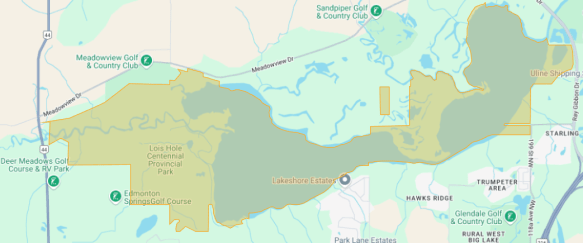
The Big Lake Environmental Support Society (BLESS) and the Stewards of Alberta’s Protected Areas Association (SAPAA) are peer organizations with similar mandates. BLESS is interested in the Lois Hole Provincial Park and Big Lake which is a large, shallow body of water that makes up a substantial portion of the provincial park. SAPAA is also interested in Big Lake plus 247 other sites dotting Alberta’s landscape.
The Devil in the Natural Detail
Scratching a bit below the surface, differences come into focus starting with the respective business problems:
- BLESS: How can members of the public efficiently and effectively report on matters arising in the park so issues can be triaged and remedied by the appropriate person?
- SAPAA: How can Trained Stewards report on the state of a site so this information can be used to inform government policy, help researchers, remedied, and inform the public?
For BLESS, time is of the essence. A moose that has expired on a trail will attract scavengers which may lead to dangerous wildlife encounters with the public.
For SAPAA, an expired moose is part of nature (unless it has been poached). SAPAA is interested in the system of natural areas and longitudinal health of the sites. The data collected is consolidated and provided to the responsible Minister, government officials, peer organizations, nearby communities, and researchers.
Mapping the Business Problem to the Information Framework
Returning to the Information Management – for Nonprofits, this difference in focus can be seen in each of the framework elements.
| Framework | BLESS | SAPAA |
| Governance: Who Controls? | BLESS board determines the questions. | Collaborative effort with the province and stakeholders. |
| Technology | An online form can perform most business functions. | Multiple systems and data feeds. |
| People | Simple and straightforward form that encourages completion. | Trained volunteers completing inspections. |
| Security | Managed by vendor; redact private information | Managed by SAPAA. Private information is retained. |
| Compliance | No PIPA* obligations, privacy statement is good practice | No PIPA* obligations. A privacy statement strongly recommended |
| Collection | Six data elements collected | Thirty-seven data elements. |
| Transform | Little to no subsequent data transformation | Mapping to other data feeds (geospatial, biophysical). Consolidated with 30+ years of site inspections. |
| Storage | Information is transitional and temporary in nature | Information is retained for decades |
| Delivery | Triaged for immediate or subsequent action. Supports annual reporting to government | Used for online reports, annual minister reports, site specific inquiries, and longitudinal studies. |
| Destruction | Delete or at least redact soon after receipt. | Held indefinitely |
- PIPA = Alberta’s Personal Information Protection Act. Discussed in a prior blog, Just Enough Information Management – for Nonprofits, PIPA is not applicable to nonprofits with some exceptions. Nevertheless, organizations may want to comply with PIPA as a best practice.
One Size Fits No One Very Well
This mini-case study shows the importance of clearly defining the business problem and using tools such as an information framework to work through solutions.
BLESS has adopted a third-party tool, Formsite [1]. While they did not conduct a comprehensive market scan, this vendor was the best out of its closest competitors. An online form is an innovative means to interact with the visiting public. Because Big Lake is close to urban areas, it is important that visitors know that the park is monitored. The cost for the online form and QR code is low, and BLESS can quickly respond to concerns. If the information is stored, it can be mined to report on trends, identify risks, and of course encourage donations and new members.
SAPAA information needs are focused on the medium to long-term. For example, Redwater River Natural Area [2] is known to be heavily disturbed with motorized vehicles, bush parties, and an illegal shooting range. This is not new. The nearby landowner has cleaned up and endured rowdy behaviour since 1990.
Collection, Problem, Framework, Solutions
Both BLESS and SAPAA started with the underlying business problems. Working through the framework lead to different solutions. For example, data collection requirements for SAPAA and BLESS are almost identical. The two organizations diverge to a greater or lessor extent on the other elements of the information framework.
In other words, it may be tempting to declare a problem solved when one element is satisfied, but this may lead to greater challenges for an organization.
References and Further Reading
- Formsite is part of the software category of ‘Forms Automation Software’. Capterra, a software comparison service, lists 500+ vendors in this category. At the time of writing, SAPAA uses Google Forms which falls into this category software category. While free, Google Forms has its own issues and is not as friendly as other form automation software.
- This site was visited by CBC as part of a story on the government’s Volunteer Stewardship Program: https://yegville.ca/2025/01/04/guns-cbc-and-natural-areas-2024-11-15/.
 Organizational Biology
Pingback: Just Enough Information Management – for Nonprofits | Organizational Biology