
Trust is a fundamental social concept learned early in life, defined by reliance and confidence between individuals and institutions. Philosophers highlight its importance for social harmony and governance, with trust types ranging from interpersonal to generalized trust. Trust impacts transaction costs and can be viewed through the lens of personal relationships versus societal expectations.
Trust is something we learn very early in life. We cry and our mouth is soon filled with nipple, a wet diaper is changed, or a soothing snuggle is given. Why write on trust? To start, it is a foundation of the concept of civil society, a topic I am investigating. The post is also a memory jog of some of the key concepts relating to trust.
How Do I (Not) Trust You – Let Me Count the Ways
Trust is a nebulous concept. Definitions typically mention verbs such as reliance, and confidence. Other words include obligation, responsibility, custody, or care.
Common definitions of trust include:
- Interpersonal: Trust between individuals — confidence that another person will act with integrity, reliability, and goodwill.
- Institutional: Trust in systems, organizations, or public institutions (government, nonprofits, courts, police, universities). Often linked to legitimacy, transparency, and accountability.
- Social or Generalized: Also known as spontaneous sociability, is the trust that people have in their fellow members of society in general.
- Relational: Built through repeated interactions; common in community development, stewardship groups, and volunteer networks.
- Competence: Confidence that someone or an organization has the skills and capacity to do what they promise.
- Other Forms: Contractual, Communications, and Ethical Trust.
It Takes Two to Trust-Tango
Implicit in the above definitions is the need for two or more parties to be a party to the trust. Even when you trust yourself there is the internal you and the corporeal thing to which you are trusting. In other words, trust is a fundamentally social activity.
Time Honoured Thinking About Trust
Philosophers from as far back as Aristotle or Confucius have written about trust being central to good governance, social harmony, and civilization. This is good news. The bad news is from the likes of Thomas Hobbes or Friedrich Nietzsche who see trust as something required or engendered by the state so as to control the more nasty impulses of the unwashed masses.
Eastern philosophers and philosophies tend to consider trust less from the individual and more embedded in the fabric of society. Trust is inherent to social harmony, a moral character, and a virtue to be pursued.
Transaction Costs and Trust Banks
Explicit or implicit in the philosophic discussion on trust is transaction cost. More trust reduces transaction costs (e.g. agreement on a firm handshake) or increases the costs (e.g. can I get that in writing?). As trust ebbs, costs rise. Conversely, as trust flows, costs decrease.
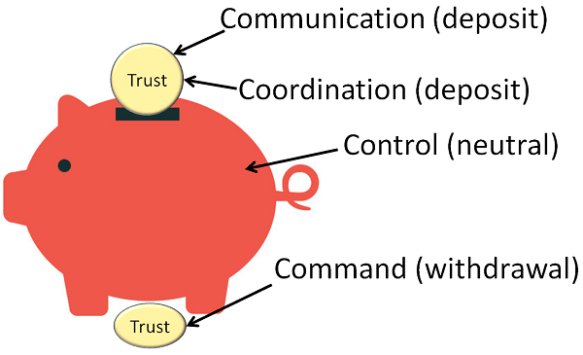
One of my favourite visualizations of trust is from the business writer Steven Covey. Covey saw trust not as a soft, sentimental virtue but instead as a hard-edged, measurable competency that determines the speed and cost of every interaction.
Covey’s Trust arithmetic has two parts, “Character + Competence = Trust“. Good intentions alone don’t create trust, and technical skill without integrity is dangerous. Another Covey innovation is the ‘Trust Bank’. Every stranger we meet starts with a small balance. Competence and ethical behaviour increases the balance. Violations of trust (dishonesty, errors, etc.) decrease it. A high trust bank can withstand the occasional mistake.
I discussed the Trust Bank concept in a previous blog 4C’ing Trust in Your Organization from which the above graphic is taken.
Trusting Through Thick and Thin
A final trust concept is highlighted in the book “Bowling Alone: Revised and Updated: The Collapse and Revival of American Community.” by Dr. Robert D. Putnam. The concept is that Generalized or Social Trust can be further categorized as either Thick or Thin.
Thick Trust arises from strong, personal, enduring relationships—family, close friends, long‑term colleagues, tight-knit communities. You trust your spouse to remain faithful, as a baby – you trust your parents, or you trust a good friend to keep a secret.
Thin Trust is what you have with strangers, institutions, and society at large—the belief that “most people can be trusted” or that systems will function fairly. It is more what the ancient philosophers were talking about when it came to social harmony.
Taking Trust Into Account
As an accountant, I spent my career pursuing, quantifying, and protecting trust. Doctors and engineers are the only professions who rank higher on a trust scale than us bean counters. Accountants perhaps take the old Russian proverb, Trust but Verify a bit more to heart. We might say, ‘Trust, but still Audit‘. Trust is great, it is even better with third party confirmation!

