
The IPOOG Model emphasizes the complexity of organizational capacity in nonprofits, highlighting their need for effective management to fulfill legal and social obligations. It categorizes nonprofits into operational, event-focused, and episodic types, while detailing essential governance and operational processes to aid their mission and sustainability.

The moment you get two or more people together, you get complexity. Before you know it, those two people are forming committees to decide what to binge on Netflix. As you scale up beyond two people, you need more organization. In addition, if you want the legal, moral, and social protections offered by a society, you need more complexity.
The Social Benefits of Hanging Out in a Nonprofit
For example, in Alberta, nonprofits are released from certain legal obligations in exchange for meeting social benefits. As a result, your daughter’s soccer team does not pay taxes on income earned flogging chocolates to buy new uniforms. The board of your son’s chess club is given legal protection for all but negligence. [1][2]
In order to sell chocolates and ensure the chess club is not grossly negligent, one needs organizational capacity. This is a term that crops up in various literatures and is defined as:
Organizational capacity is a nonprofit organization’s ability to effectively and sustainably achieve its mission through leadership, resources, systems, and adaptive capabilities it mobilizes and manages. [3]
Breaking Down the Capacity Definition
The above definition is broken into 5 parts:
- Nonprofit organization’s ability. The focus of this blog is on the nonprofit but commercial and governmental organizations can use capacity as well.
- Effectively and Sustainably. Nonprofits are land of manual work arounds. These are examples of The Burden of Volunteering. Conversely, technology and complex processes are a good way to disengage volunteers. Business processes must be both effective (get the job done) and sustainable (within the bounds of an organization’s Time, Talent, and Treasure).
- Its Mission. This can be challenging for nonprofits. Missions are subject to scope creep. Organizational Capacity is a big problem when you are trying to be all things to all people. Mission also includes the legal, industry, and moral obligations required of the organization.
- Leadership, Resources, Systems, and Adaptive Capabilities. These are the ‘things’ of organizational capacity. Another way to describe this list is to say, an organization’s Time, Talent, Treasure, and Processes.
- Mobilizes and Manages. An organization may have a large cadre of volunteers but if no one shows up when asked, an organization might as well have no volunteers. Mobilizing and managing is the secret sauce of an organization.
To summarize, Organizational Capacity is the ability to consistently get sh*t done.
We Are All the Same Except When We are Different
There are some common things that all organizations do (for/non-profits, governments, etc.). Every organization needs a board of some sort, they need to account for resources, report to shareholders/members/statutory bodies, and of course operate.
For profit entities operate for the benefit of the shareholders. Governments operate for the benefit of the citizens (or the autocrat of the day). Nonprofits have a stated benefit for their members, society at large, etc.
Nonprofits are just like for profits except for when they are different. As well, all nonprofits are the same except for when the differ from each other.
Non-Profit Flavours
To the last point, that each nonprofit is different. One way to categorize nonprofits was introduced in the context of volunteer management, see: Non-Profit Flavours.
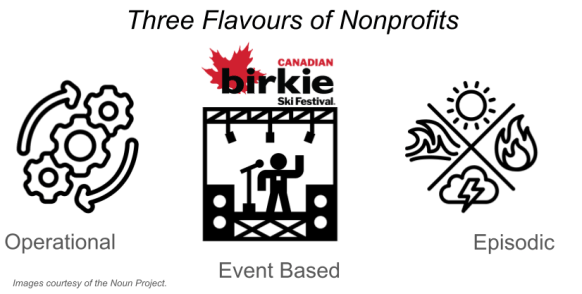
- Operational: A food bank, museum, school or a homeless shelter. Their products or services are continuous and ongoing. They have similar problems to most commercial organizations. They need to find good people and schedule them. Throughput, cost per unit, and matching outputs to funder priorities are characteristics of an operational non-profit.
- Event Focused: Delivers one or more events within a narrow timeframe. Examples include: festivals, a car rally, or the Canadian Birkebeiner (Birkie) cross country ski event.
- Episodic: These are less common and they deliver their services intermittently and at an unknown time. A search and rescue organization is an example. While this organization’s service delivery is intermittent, preparations for the delivery are ongoing.
What are the Minimum Obligations of a Nonprofit?
Buried deep in the discussion of a Nonprofit’s ‘Its Mission’ is the requirement to meet its legal, industry, and moral obligations. These are the minimum even for the most inactive Alberta based society.
| Obligation | Primary Source |
|---|---|
| Incorporate | Complete the paperwork and filings to be a registered society. See Is Nonprofit Incorporation Worth the Bother? |
| Hold an AGM | Alberta Societies Act, s. 25 (Annual General Meeting) |
| Annual Return | Alberta Societies Act, s. 26 (Annual Report/Annual Return filing) |
| Audited financial statements | Financial statements must be audited. This is typically done by two members or a CPA firm. |
| List of Directors or Officers & updates | Alberta Societies Act, s. 27 (Officers and Directors), together with the society’s bylaws governing elections and terms of office. The titles and nature of these positions is defined in the bylaws. |
| Membership records | Alberta Societies Act, s. 36 (Register of Members, etc.). |
Even an Inactive Organization Does Things
A society can remain in good standing with the Alberta government for years as long as it does the above activities and has no other statutory obligations. Implied in the above list are the following business processes:
- Planning and communications: to organize the Annual General Meeting.
- Leadership: to fill officer positions
- Bookkeeping: to prepare the financial statement and have it audited.
- Membership management: to store and manage the list of members.
- Information Technology: manage the finances, membership list, or call the AG.
- Secretariat: amalgamate the annual report materials and transmit them to Service Alberta.
Organizing Organizational Capacity
Organizing what a nonprofit does is challenging but not impossible. To do this, the IPOOG Model will be used. IPOOG stands for:
- Input: Flow of data and materials into the process from external sources. Inputs are the raw materials or information that need to be transformed (What Goes In?).
- Process: Tasks required to transform the inputs including activities, procedures, and operations that occur during the process (What Do We Do?).
- Output: Outputs are the data and materials flowing out of the transformation process. They represent the results or outcomes produced by the process (What is Delivered).
- Outcomes: Short and medium-term effects resulting from the outputs. They represent actual changes or benefits resulting from the activities (Results).
- Governance: Oversight to the above activities to ensure they are still required, operated in an efficient manner, and resources are available.
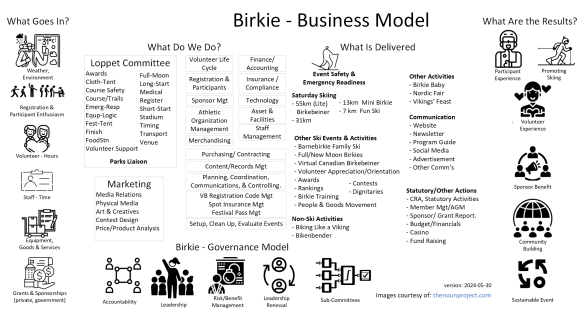
IPOOG was introduced in the 2024 Birkie Business Model. While there are a few dozen other variations and hybrid versions, IPOOG tends to be ‘good enough’ and reasonably intuitive. For example, the following graphic, although busy, lays out everything that one nonprofit, the Canadian Birkebeiner Society does to put on an annual cross country ski festival.
Next Stop – In Depth IPOOG
The point of this post was to layout the surprising complexity and variability in trying to understand nonprofits. Each one is unique but there are common requirements and models such as IPOOG can help to categorize and identify like activities.
As the above Birkie Business Model demonstrates, volunteers manage complex organizations. These nonprofits deliver benefits to civil society for a fraction of what they would have cost had a commercial enterprise attempted to do so. Perhaps society and umbrella organizations can help.
To start, what makes up a typical IPOOG? What are the business processes that most, or every, or only a select few nonprofits will use? From this list, which processes are critical for the organization, which can be abandoned, and are there processes that can be outsourced? This leads us to the next step, a comprehensive-ish list of business processes categorized by IPOOG.
See you at the next blog!
Notes and References
- Technically being an Alberta Society and filing Canadian taxes are two separate matters and sets of legislation. The thresholds for when a nonprofit has to file taxes is out of date (e.g. from the mid-1990’s) and, as a result, are exceptionally low. This is a great topic for organizational capacity and the above is meant as a short hand for a nonprofit.
- When is an entity a nonprofit, a society, or a charity? These terms have specific meanings defined in statute or generally understood. To avoid bouncing back and forth, I am using the terms nonprofit and society interchangeably for this blog.
- A cursory internet search suggests the following most authoritative definitions for the term “organizational capacity”. The above definition is a mashup of these. For further reading, see the table below noting: Artificial intelligence (Microsoft Copilot) was used to assist with research, source identification, content synthesis, and drafting. All content was reviewed, verified, and finalized by the author.
Common Definitions: Organizational Capacity
| Rank | Source | Definition | Reference |
|---|---|---|---|
| 1 | McKinsey & Company / Venture Philanthropy Partners (2001) | Organizational capacity refers to the collective capabilities, resources, and systems that enable a nonprofit to achieve its mission effectively. The report introduced the widely cited “Seven Elements of Nonprofit Capacity” framework. [digitalartscorps.org], [search.iss…ab-dev.org] | Effective Capacity Building in Nonprofit Organizations |
| 2 | TCC Group (Core Capacity Assessment Tool – CCAT) | Capacity is a nonprofit’s ability to carry out its mission effectively now and in the future, through leadership, adaptability, management, and technical capabilities. [nlctb.org], [tccgrp.com], [guidestar.org] | TCC Group CCAT |
| 3 | UNDP (United Nations Development Programme) | “The ability of individuals, organizations and societies to perform functions, solve problems, and set and achieve objectives in a sustainable manner.” [lencd.org], [undp.org] | UNDP Capacity Development Primer |
| 4 | OECD Development Assistance Committee (DAC) | “The ability of people, organisations and society as a whole to manage their affairs successfully.” [lencd.org] | OECD Capacity Development Overview |
| 5 | European Centre for Development Policy Management (ECDPM) | Capacity is “that emergent combination of individual competencies, collective capabilities, assets, and relationships that enables a human system to create value.” [lencd.org] | LenCD Capacity Definitions |
| 6 | Hall et al. (Canadian Centre for Philanthropy, 2003) | Capacity is the ability of an organization to carry out its objectives and effectively fulfill its mission. This became the foundation of much Canadian nonprofit capacity research. | https://imaginecanada.ca |
| 7 | Alliance for Nonprofit Management | Organizational capacity is the combination of leadership, management, governance, and resources that enables organizations to achieve mission and produce results. | https://www.allianceonline.org |
| 8 | Urban Institute Nonprofit Research Program | Capacity is an organization’s ability to marshal and deploy resources to accomplish goals and serve constituents effectively. | Urban Institute Nonprofits |
| 9 | Allan Kaplan / Community Development Resource Association (CDRA) | Capacity is “the ability [of an organization] to function as a resilient, strategic and autonomous entity.” [lencd.org] | LenCD Capacity Definitions |
| 10 | New Zealand Council for International Development (NZCID) | Capacity is “the measure of an NGO’s ability to satisfy or influence stakeholders, consistent with its mission.” [lencd.org] | LenCD Capacity Definitions |

