Nicholas Taleb is back with a new book, ‘Antifragile: Things That Gain From Disorder‘. Okay the book has been on the market for a few years but I am behind in my reading.


Nicholas Taleb is back with a new book, ‘Antifragile: Things That Gain From Disorder‘. Okay the book has been on the market for a few years but I am behind in my reading.
In Malcom Gladwell’s book, ‘David and Goliath’, he refers to the ‘principle of legitimacy’. These principles are the basis (or lack thereof) for why one group will allow themselves to be subject to another.
The principles stress that it is the behaviour of the leaders that determines whether or not the followers will follow. At least, the principles indicate whether the followers see the leaders as being legitimate [1].

Walter Gadsden, 17, was attacked by police dogs on May 3, 1963, during civil rights demonstrations in Birmingham, Ala. (Bill Hudson/Associated Press) , courtesy of http://www.boston.com [3]
The writing brilliance of Gladwell is that he introduces this concept first in a kindergarten and then applies it to broader contexts such as Northern Ireland or the segregation laws of American South pre-1960. In these examples, Gladwell extends the theme of his book in which an advantage may in fact be a disadvantage.
For example, the British Army in Northern Ireland had the men and material to temporarily impose control over the local population but not to sustain it because they failed to establish legitimacy amongst both the protestant and catholic populations.
Strong armed tactics doomed the British Army to decades of occupation and directly or indirectly resulted in the death of hundreds if not thousands of combatants and civilians. The principles of legitimacy are not without their consequences.
Gladwell does not have the space in his book to discuss is how much or how little of each are needed based on varying circumstances. There are circumstances where one of the three is reduced to nearly zero (try asking for a voice in the arrangement during the first week of army boot camp).
Alternatively, is there such a thing as too much of these principles? Do they break down when taken to the extreme? Have you ever been ‘surveyed’ to death by an employer asking about your degree of motivation or engagement with the company?
How about rules being applied too consistently such that the application actually erodes the legitimacy. A ten-year old child who is expelled from school because they made an imaginary gun out of their fingers is an example of a zero tolerance policy gone horribly wrong [2].
The take away from Gladwell’s book is that these three principles of legitimacy are just that – principles. They are not hard and fast rules and leadership is in their application rather than their memorization.
Here are some of my thoughts on considerations before over-applying one of the three principles of legitimacy:
For business leaders, is there anything new here? Yes and No. Societies with the greatest longevity have adhered to these principles. These principles are also the hallmark of good leadership and good governance.
If you want to build an enduring organization that will outlast you remember that those being led:
Leadership is still hard but authors such as Malcom Gladwell can help us to challenge our assumptions and become better, more legitimate, leaders.
As the Director of Programming for the Edmonton chapter of the Financial Management Institute, I get the chance to bring great topics to our members. Our Chapter’s focus is on programming of interest for our members who are public servants in the greater metro-Edmonton area. On March 12, the board is conducting its planning session for the 2015-16 program year. This is your chance to contribute to the planning process without having to attend a board meeting (although if you want to volunteer…).
Leave a comment on this page with your idea. A title is welcome but if you have a paragraph or two to add even better. The items below list the potential topics of interest. The sequence of events will be as follows:
Our current ideas are as follows and are listed in no particular order, tentative sessions are just that, tentative.
Internal controls are central to the fiduciary responsibilities of financial professionals and financial managers in the public service. How good are your controls, is passing an audit enough and can you have too much control? These are the questions that a panel of experts will discuss including examples from the real world of auditing.
(Suggested by George W) What are the major capital projects being built in Alberta and what is the role of either by either public or private interests in their development? This session will look at a state of the projects and how public servants can assist and support capita project based economic growth. Also discussed will be the challenges of maintenance after completion, what are the options for keeping the lights on after the ribbon has been cut.
(Suggested by Neil P) In 1936, Dale Carnegie wrote ‘How to Win Friends and Influence People’. 80 years later, the nature of business may have changed dramatically, and continues to change… yet the basic principles of human interaction and workplace communication have, in essence, remained the same. Given the changes in today’s world and business environment, the humanity of his teachings are more crucial now than ever before, and the ability to win friends and influence people in business is an increasingly important skill. This seminar will teach you how to manage people and give you the crucial foundational skills to shift from being an individual contributor to a well-respected manager who can achieve team success.
(Suggested by Sue K) Public servants are expected to be innovative while working in a risk averse environment. This inherent conundrum is compounded during times of fiscal restraint when ideas are solicited but resources to execute few. This session will investigate innovation in the public services from a number of facets. Firstly, what is innovation, how do you get it, how do you keep it and when should you ignore it? Next, how to propose, implement and sustain an innovative idea or culture in an environment that is less than ideal. Finally, thoughts and strategies of making the case during times of fiscal restraint, after all, never let a good crisis go to waste!
(Suggested by Neil P) Public servants and financial managers spend a good portion of their working day in meetings. But what is the result from this time spent? This session will help you be more effective through both other standing the psychology and practical skills. Including in this section is how ‘Roberts Rules of Order’ can help you be more productive in a meeting without sacrificing innovation or open communication.
One pervasive constant in the public service is the existence of unions across all levels of government. This session will consider the benefits to the members, citizens and taxpayers unions play and what are the corresponding costs or inefficiencies they introduce.
(Suggested and contributed by Rene M and Darci S) Ministry re-organizations and municipal re-engineering have been with public servants since the initial governments. Why do re-organizations occur in the first place from the political level, who has mastered the art of surviving and what can a public servant take away from or contribute to the re-organization? Beyond the structural changes, what are the specific challenges in changes in leadership and the loss of corporate knowledge at the executive level. What are the impacts to managers, non-managers with a specific focus on the role of the finance person in the reorganization.
An exploration of the healthcare expenditures made within the province and nationally. How can this expenditure can be maintained, what is the impact on government revenues (at all levels) and how will it be affected by the aging of the Baby-Boomers. A panel discussion will occur.
Canada has 3 levels of government, federal, provincial/territorial and municipal/aboriginal. How do these government levels work, what are the similarities, differences and nuances for each? What should a financial manager or public servant know about these similarities or differences? This event will include presentations from past and present sitting politicians and a tour of the Alberta Legislature.
(Contributed to by Nobey) Known by many names and methodologies (Results Based, Zero Based, etc.), a performance based budget strives to link inputs (financial and other resources) with the outputs and intended outcomes.
In theory, a perfect model for allocating the scarce resources available to a public service. In practice though, what have been their successes and challenges?
These are the perspectives and challenges FMI will explore in this engaging panel discussion and presentation formatted conference. Of interest to all who hold, manage or rely on public-budgets.
In June 2013, the first ever province wide state of emergency was declared. One of the most destructive natural disasters occurred in which large portions of Southern Alberta was under water. Looking back two years, what are the lessons learned for all levels of government in emergency response. How can the Public Service be both agile and maintain the fiduciary responsibilities expected of it. In addition to the 2013 Southern Alberta Floods, lessons from the SARS epidemic, Slave Lake Fire and Forest Fires will be considered. This session will be of interest to any public servant interested in planning for the unexpected.
(Suggested and contributed to by BTH and Bageshri V) In February 2015 the FMI asked the question, Procurement who does it well? At this session we will return to procurement but with a larger supply chain focus and ask who is doing procurement even better? Included in this session will be a return to the Government of Alberta’s Contract Review Committees – xx years after their inception.
(Suggested by Dianne L) The Microsoft collaboration tool SharePoint has become the new standard in offices. Unfortunately for many organizations, it quickly becomes simply another network drive – and not a particularly good one at that. In this session you will learn 5 things that you may not have known SharePoint could do: 1. Be your go-to Desk Reference/Procedure resource; 2. De-clutter the infamous network drive; 3) Become a budget system – without (almost) using Excel; 4) Store emails and declutter your inbox; 5) Used as a ministry/department priority tracking system.
Time and attention has become the new precious commodity for busy professionals. Email, smart phones and pervasive technologies nibble away at the twenty-four hours allocated each day to deal with business, family and personal priorities. What are the philosophies, techniques and methods to make the best use of those twenty-four hours?
Budgets are central to a public service organization. In many ways they are as important or perhaps more important than even the financial statements. This is particularly so in organizations using the Westminster model of budget approval (e.g. the provincial or federal governments).
Given their importance, who does budgeting well? Who has clients that love the system and who can produce reliable and forecasts quickly? This session will explore these questions and opportunities from four lens, the system, municipal, provincial and federal perspectives.
(Suggested by John K) Public servants and in particular financial managers are asked to lead, contribute to, evaluate and then manage to a variety of plans. But what exactly does the organization when they want a strategic/operational/business or risk plan? What are the common elements in these documents? More importantly, how can public servants prepare credible, useful and enduring plans from that ever so-edge of the side of their desk? This session will provide definitions, tips, tricks, guidance and most important, clues how to plans that spend as little time on the shelf as possible.
(Suggested and contributed to: Chris M and Darwin B) It is a truism that systems are the new bricks and mortars for organizations. Unfortunately with this importance comes the risk when they are not well designed, implemented, run, managed or governed. This session will look at the last two challenges in the context of two systems – how best to manage and govern an organization’s Enterprise Resource/Risk Management systems? This will include topics such as – what should be the vision for these systems, who should be the governors, the managers, the users with the voice and to integrated the disenfranchised users? As well, best practices/examples will be discussed from both local metro-Edmonton and from further afield.
PSAB, IFRS and IPSAS means that accountants are increasingly less tied to specific industry, employer or even country. What are the risks, rewards and opportunities for a professional accountant to take a secondment or leave to parts unknown? What is the value proposition to the home and receiving organization? How should family, career and community factor into this decision?
On November 1, 2012, IPAC-Edmonton and FMI held a joint conference to hear about initiatives to renew the public sector from its senior leaders. The panelists included Simon Farbrother (City Manager, City of Edmonton), Peter Watson (Deputy Minister of Executive Council, Government of Alberta), and Jim Saunderson (Chief Financial Officer – Western Economic Diversification, Government of Canada).
Three years on, what has changed and is renewal still a priority for governments? What are the specific risks for the provision of financial, accounting or economic services? This conference will revisit 2012 and look forward another three years in the context of public sector renewal.
(Suggest by John K) for accountants working in non-traditional finance areas, it is easy to get rusty on the standards that underpin our work. This refresher will provide a whirlwind tour for the financial manager on the accounting standards in force and that influence the public service. This will include the legacy Canadian CICA, International Accounting Standards (IAS), International Financial Reporting Standards (IFRS), Canadian Public Sector Accounting Board (PSAB), International Public Sector Accounting Standards (IPSAS).
(Suggested by John K) Many organizations employ 360 reviews to help employees better understand themselves through how others perceive them. During this session, the 360 review will be explained (including its strengths, shortcomings, costs, etc.) and how you can collect feedback informally about yourself through less formal means.
(Suggested by Carey M) Accountability and oversight comes in many forms. What organizations have mastered the subtle art of enough control that does not destroy innovation in its ranks. This session will look at that delicate balance including special focuses on the federal and provincial treasury boards and municipal equivalents.
(Suggested by Ron M) Edmonton is a government town. What may surprise you though is exactly how much government is going on in our area code. Within a hundred kilometres of the legislature dome there are xx independent government levels and organizations. This includes the federal, provincial, municipal, first nations, crown organizations (agencies, boards and commissions) – and don’t forget the universities, schools, Alberta Health Services and other full and partially arms length entities. How well does these entities cooperate with each other at a political, executive, financial management (yeah FMI!) and professional level. What can be done to improve this cooperation and is there a dark side to knowing your neighbours a bit too well?
(Suggested by Lucia S) How well do you perform when it comes to critical thinking and analysis and how well do you communicate the results? This session will explore the dark arts of critical thinking and combine it with how to present and communicate such analysis in a simple and effective manner to executives and to the political level.
(Suggested by Sandra V) Teams or at least work units are the basis for most organizational structures. How can financial managers build better teams and how can financial professionals and public servants be better followers and contributors to a team? More importantly, how to balance the success of the team with individual performance management and promotion. This session will explore these issues and concepts.
How well does your organization manage the asset life cycle? How is that asset verification thing working out for you? Are your organization policies, procedures and technology current or are they getting a bit stale? Finally, do you understand the accounting standards relative to tangible, intangible, component-ization or work in progress accounting? This session will examine the asset life cycle, who is doing it well, the standards and what could be done better.
(Suggested by Xin N) Individuals are appraised by teams produced! However, how do you build effective teams, resolve conflict and create a healthy work place when the demands on the individual public servant have become greater than ever? This session will provided you with practical skills in team building and work relationships so as to keep your individual sanity and your team effectiveness.
An old saw goes, ‘What gets measured gets done’. However in dueling quotes, Albert Einstein said: “Everything that can be counted does not necessarily count; everything that counts cannot necessarily be counted’. Thus the challenge of performance measurement in the public service. What are the acknowledged performance measurements for government organizations, how can the costs to collect these measures be reduced while improving their accuracy, finally, what is the role of the financial professional to managing measurements (both financial and non-financials).
Full costing of government is a challenge. Central services (finance, human resources, IT, etc.) are often seen as a ‘free-good’. Nevertheless, stakeholders (taxpayers, citizens, politicians) want to know the cost of delivering a project, program or service. Twenty years ago, activity based costing, budgeting and management was one method to accomplish transfer pricing – since then the accounting world has become largely silent for these techniques. This session will discuss the value and purpose transfer pricing, the existing accounting standards and success (and not so success) stories.
A central role of financial managers and public servants is to ‘speak truth to power’; however truth needs to be based on good information and evidence. What are the sources of information that can be used to make good decisions? How do public servants manage information that is growing faster than the ability to assimilate let alone understand it. This session will allow the public servants to understand what is information, how can it be managed, how it can be used for decision-making and how is this a good career tool.
Activity Based Costing (ABC) and Budgeting (ABB) have seen their fortunes rise and fall over the past few decades. The Alberta Government has passed the Results Based Budgeting (RBB) Act which seeks to systematically review all government programs and services from an output and outcome perspective. This session will discuss the role cost accounting/budgeting plays in this new world at all levels of government. What are the human, system and cultural changes needed to make RBB, ABC, ABB or any other similar resource allocation process successful?
This is the second in a good intentioned series of blogs detailing my experiences and uses of the tool. The first blog, SharePoint 101, provided some context and a ‘fictional use-case’ which the following blog is based on.
Continue readingI like SharePoint, it is not a love-level relationship but it has matured definitely to the like stage. Through this and future good-intention blogs, I want to put down what I think are some pretty cool ways to use SharePoint and just as important, some good ways to use the tool.
If you are reading this and have never used or heard of SharePoint, go onto some of my other postings on this website. Unfortunately SharePoint is kinda hard to explain and so therefore I will assume that you know about the following things:
If any of the above is makes you go huh?, sorry I can’t help you but I can point you in the right direction:
… but before you start using SharePoint, here is something to recognize about how not to use SharePoint. Don’t use SharePoint as a glorified Network File System. It can do so much more, so why do so many people do so little with it? Hopefully the next few blogs will give you just some examples.
In my ongoing effort to remember what the heck I have done, I have the good intention of writing a series of blogs about some cool uses of SharePoint (and associated technologies). Check back to read about cool stuff or to see a post of shame of good intentions gone bad.
I have used SharePoint for a variety of uses including:
For the purposes of this and other blogs, I will use a fictional example of a budget site in which internal clients need to submit content and documents. This example will centre around a government organization and specifically one that primarily manages projects but also manages contractors, contracts and staff.
Information Management/Technology (IM/IT) is expensive. As well, the advantages it provides are fleeting and easy to imitate (or worse steal). An organization must strategically and operationally plan for its investments in IM/IT. The problem is, what exactly should be in the Strategic or Operational plan, and what are the questions the plans are trying to answer?
Over the past 20+ years I have being pondering these questions. Being a visual person, I have developed what I am calling the SWOT+4 IM/IT Planning Model. It is a bit busy but here it goes. At the centre is the SWOT matrix. Overlaying the SWOT matrix are the four-central IM/IT questions and on top of the questions are the respective planning tools to answer the questions.

SWOT+4 Planning Model
At the core of the SWOT+4 model are the organization’s Strengths, Weaknesses, Opportunities and Threats. This 2×2 matrix is a mainstay of strategic analysis. Although familiar to virtually everyone, in brief it is a method to view a situation from two key dimensions: internal versus external and positive versus negative. For example, Strengths are internal-positive attributes whereas Threats represents the external-negative possibilities.
Unfortunately, the SWOT tool is incomplete when it comes to evaluating an organization’s IM/IT. For example, is a change of technology an opportunity or a threat? Are the existing IM/IT systems a strength or a weakness? The answer to both questions is – it depends. As a result, I have used a Four Question Model for IM/IT Planning over the years as an analysis checklist. In order of priority the questions are:
Finally two typical planning tools are overlaid on the SWOT and 4 questions. The bottom and foundation is the organization’s business or strategic plan. IM/IT may have its own strategic plan or it may piggy back on a larger corporate plan. Irrespective, the plan should be able to answer the questions of (q1) what is important and (q4) what is on the horizon for the organization? The IM/IT operational plan focuses on the questions of (q3) current capacity and (q2) near term organizational IM/IT activities.
The delineation between the plans is not clear and ideally they should overlap each other rather than having a gap. The operational plan purposely extends into the Threat quadrant of the organization and the Business Plan relies on organizational strengths to capitalize on opportunities in the environment.
What do you think? Is the SWOT+4 Planning Model a muddled mess or does it provide a conceptual basis in which your organization can begin to structure its IM/IT planning. What is the value proposition to understanding and using the model well? I believe the model can support faster technology adoption, lower cost of implementation and ownership and better leveraging of IM/IT assets. Stay tuned as I am hoping to drill in a bit more into the model in future blogs. For example:
On the off chance that you have been wondering where my blogs have gone, I have been putting the finishing touches on an article to be published (hopefully) in the next issue of the FMI Journal. Writing, especially when you do if for free, is a labor of love and you don’t do it alone. Beyond relying on one of the best editors/critics in the world, my wife Margreet, this time around I also had some help from former colleagues.
This is the first time I have used what I am calling a ‘friendly-peer-review’. Certainly friends and colleagues have read prior articles and provided comments, but this time around I asked for help in a more systematic manner. The result was a much better article with perspectives that would never considered or with bad bits beaten out with bats.
Of course no good deed ever goes unpunished and to that end, the following are folks who have helped me with the friendly-peer-review. Hopefully I can return the favor in the future. Also, if you are on the list and are logging this as professional development, feel free to refer to this post and notice below.
|
Person |
Organization |
| Aaron F. | Alberta Health Services |
| Conor O. | IAEA |
| Leanord T. | Deloitte Canada |
| Neel G. | IAEA |
| Neil P. | Government of Alberta |
| Richard I. | Government of Alberta |
| Shawn M. | Western Economic Diversification Canada |
| Steven S. | World Intellectual Property Organization |
| Stewart S. | Private Contractor |
| Terry E. | Private Contractor |
To whom it may concern, the above individuals were asked to perform a friendly-peer review of an article intended to be published in the Financial Management Institute of Canada journal, FMI*IGF Journal. The estimated time to perform this review was between 2 to 3 hours. All of the above individuals demonstrated a firm grasp of the subject matter and helped to createnet-new original thought and critique through this peer-review which will be reflected in the final article. I welcome contact if further confirmation is required.
This is a relative new (e.g. only a few years old) Phrankism for me. During recent circumstances, I have found myself using the phrase ‘Air Cover’ more often. As a result, it is probably time to define it and place it in its proper place in the ‘Phrankism-Hall-of-Fame’.
The Free Dictionary: air cover, n (Military):
the use of aircraft to provide aerial protection for ground forces against enemy air attack
The Free Dictionary: Extraction, n (Military):
In military tactics, extraction (also exfiltration or exfil), is the process of removing personnel when it is considered imperative that they be immediately relocated out of a hostile environment and taken to a secure area. There are primarily two kinds of extraction:
- Hostile: The subject involved is unwilling and is being moved by forceful coercion with the expectation of resistance. Essentially, it is kidnapping by military or intelligence forces.
- Friendly: The subject involved is willing and is expected to cooperate with the personnel in the operation.
Oxford Dictionary, air cover, noun:
protection by aircraft for land-based or naval operations in war situations: ‘they provide air cover for United Nations convoys of relief supplies‘
Oxford Dictionary, extraction, noun:
the action of extracting something, especially using effort or force:
As a Phrankism, it is a military term borrowed to provide good imagery within an organization. My current working definition (e.g. until someone comes up with a better one and I steal it) is:
The support of one’s superiors, organization and/or colleagues while undertaking an assigned task which involves some risk or need for unanticipated resources. Generally any guarantees are provided in an informal and often verbal manner rather than via a formal organizational structure.
Air Cover and Extraction are based on trust; in particular trust at a personal level between a subordinate and the superior/organization. In this case, the trust includes:
The first two points of trust are top down. They can also be used to mitigate organizational practices such as Drive By Management or Management through Magical Process. A word of warning to organizations about trust; the late Steven Covey in his book, The 7 Habits of Highly Effective People, explored the idea of an emotional bank account. When meeting someone new, everyone starts with a small positive emotional account balance. They then make contributions or withdrawals based on their actions. The more one contributes, the higher the trust; the more withdrawals, the greater the suspicion and lack of trust. In other words, offering air cover and then leaving a subordinate to languish on the beachhead is a sure-fire way to start you down the road of a dysfunctional organization.
Points three and four are about trust going from the bottom up to the top. If your superior is expecting status reports, provide them! If your boss would have helped you out of a pickle – but you never asked – you have violated your trust relationship.
On the fourth point, a person going back into a situation without authorization, works in adventure movies but seldom in real life. Think about the action hero who violates a direct order and heads back to rescue the damsel or save the world. Some by the book superior is cursing him/her as they see the rocket ship/parachute/starship fly away. Nevertheless by the end of the movie, the hero saves the day/world/universe and all is forgiven and the superior is proven wrong.
In the real world, quit when you are ahead. An organization or a boss may rescue you once. Going back and trying again, without permission, is a trust-busting activity.
Air Cover and Extraction can have a formal arrangement. For example, the structure of an organization is designed to delegate authority down and allowed a set of pre-approved decisions to be made by subordinates.
Informal Air Cover and Extraction is a tactical tool the organization can use in specific circumstances. Like any good tool, its utility is understanding when it is not being used enough (e.g. an organization is stagnate, dysfunctional or moribund in bureaucracy) or too much (e.g. words such as cowboy, free-for-all, loose cannons or out of control are used to describe the organization… and hopefully not by the auditors or shareholders!).
The balance of just enough Air Cover is a sub-theme found in some previous blogs (see list below) and one which I hope to return to in future blogs. What are your thoughts on this? Leave me a comment but please don’t ‘carpet-bomb’ my site!
Further OrgBio thoughts on the themes of Air Cover and Extraction are as follows… in order of relevance:
This is a third blog in a series on ‘Paying Your Volunteers Well‘. All of the blogs in the series have been on the theme that organizations pay their volunteers via three ‘currencies’ of which Experience is the third.
Continue readingNow that cycling season is over, it is time to get back to thinking about Organizational Biology – and this includes updating Phrankisms. What really jogged my memory (and motivation) was coming across a couple of old Dilbert cartoons introducing the concept of ‘Drive-By-Management’.
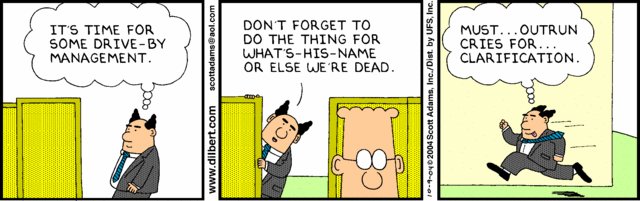
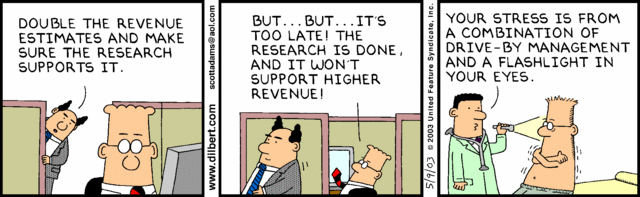
Provide courtesy of www.dilbert.com per the Uclick terms of use policy, all rights reserved by Uclick and its associates.
The urban dictionary defines Drive By Management as:
A management style bearing the characteristics of a drive-by shooting. Typically, this involves firing off pointers at subordinates with a total lack of regard for accuracy or willingness to take personal responsibility. The manager will then make a quick getaway without accomplishing anything.
I am not sure that quite captures my thoughts on the matter so my definition is:
The assignment of work objectives without the opportunity to negotiate the corresponding details to ensure an optimal result. These details may include due dates, quality or quantity measures, the purpose or ultimate use of the output and a discussion on how to improve the quality and productivity of similar, future requests.
So, what is the problem with Drive-by-management? Heck, think of a John Wayne war movie where he orders (or is ordered to) take that hill/building/machine-gun-nest. The doomed squad goes off with determined grit on their face to achieve the objective despite the possible costs. Later, a smaller number return having achieved the objective and saving the day. Hearty pats on the back and more determined gritted-faces follow. What is not to love about Drive-By-Management!
From a leadership position, the ability to send men (and women) off to do the impossible, without the bother of having to provide details or context, sounds pretty good. In reality it does not work that way. Let’s go back to Mr. Wayne and the military example.
Militaries don’t tend to willy-nilly send their soldiers off to certain doom simply because soldiers, in particular modern ones, are hard to come by. Perhaps the last time we saw such willy-nilly’ness on a large-scale was during the First World War. Thus a military squad capturing a hill is actually not really Drive-By-Management. Before being sent off, the squad has had training on such things. It benefits from resources such as weapons, supporting fire, and communications between it and the rear. The squad also has a visible objective – the hill/building/machine-gun-nest. After the objective is achieved, it will be carefully documented in the war diary and will likely be debriefed and evaluated by the higher-ups to see what can be learned for the next hill/building/machine-gun-nest. As a result John Wayne and real life equivalents display very little Drive-By’ness.
A better military example of Drive-By-Management in a military context is the Charge of the Light Brigade. If you don’t know the history the summary is there was:
The result was a great poem by Alfred Tennyson, the death of 156 men, and the loss of a critical fighting force the English could have used later on if it had not been wasted.
This is where the catchy name/metaphor breaks down a bit. Drive-By-Management is easy to thwart by the driver getting out of the car and asking such basic questions as ‘Do you understand or can you do it?’ The person on the receiving end has the ability to stop the car and ask questions such as ‘When do you need it or how will it be used?’ This is where Drive-By-Management meets Management-By-Walking-Around (and the subject of some future blogs).
In the meantime, what do you have to say; have you been a recipient of Drive-By-Management recently? Alternatively, have you been the one doing the driving? My impression is that Drive-By-Management is more prevalent to the public service but I have no real data to support this (and I see yet another blog on the subject). As a result, any comments or perspectives would be greatly appreciated.
 Organizational Biology