Can We Start Again Please – Here is the Offer…

On September 16, 2021, I will be moderating a Financial Management Institute (FMI) virtual conference: Getting Up to Speed When the Pressure is On. The conference will present six senior Edmonton area leaders [2] who have recently started their new roles. Edmonton Chapter – “Getting Up to Speed When the Pressure is On” | fmi*igf.

A large snail with shell proceeding past a bike tire in the background.
Moving to a new role is always daunting.
Continue reading

Zoom Tips, Tricks & Hacks with Tony White

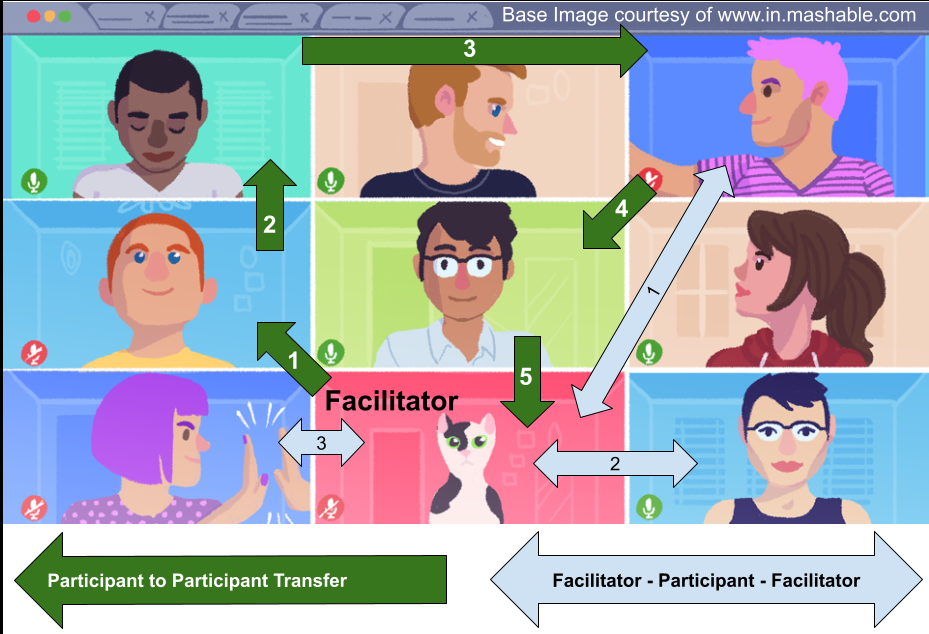
My notes from a session hosted by Tony White, a consultant and training specialist from Ontario [1]. This 3.5-hour session was hosted by the Canadian Executive Services Organization (CESO) and was well run and informative.

Gallery view of a Zoom image has communication originating and then returning to the facilitator (blue arrow).  Alternatively, the 'floor' moves from participant to participant returning to the moderator (green arrow).
Blue Arrow: Moderator Centric Facilitator Using a Gallery View. Green Arrow: Participant Centric. (image courtesy of mashable.com)
Continue reading

The Game of Sudden Wealth

For most people, we accumulate (or not) wealth slowly, year over year. We work, save, spend, borrow and then go back to work. For the (un)lucky few, wealth comes suddenly which can give rise to Sudden Wealth Syndrome (SWS).

Nicolas Cage, perhaps the poster child for Sudden Wealth Syndrome
Continue reading

I Want to Learn

A core premise of adult learning is that the individual must have influence over the content of the instruction. In a workshop setting, this can be done by asking participants to rate both their knowledge of a topic and the relative importance a topic is to them relative to the time and attention available in the session.

Continue reading

A Logical Framework

I am brushing up on a few concepts and processes that I have used in the past and may very well need to use in the future.  One concept concerned a business philosophy of Results Based Management (RBM) and a tool RBM uses for project design, the Logical Framework (LogFrame).

Matrices of the Logical Framework.  Rows are in ascending order: Goals, Purpose, Output and Activities.  Columns, left to right, are: Summary, Indicators, Verification and Assumptions.
Logical Framework Matrix – Overview of Columns and Rows
Continue reading

Pin the Tale on the Disruption

This is a conclusion of a previous blog series entitled ‘Seven Days of Disruption‘.  These blogs discussed a variety of potential disruptions that could affect the public service.  During a Financial Management Institute conference entitled ‘Disruptive Writers‘ on November 22, 2017, 110 presenters, attendees and volunteers were asked to rank one of 18 disruptions as having the greatest impact on the Canadian Public Service over the next 10 years.  This blog will describe the game ‘Pin the Tale on the Disruption‘ (in case I want to use it in the future) and describe the results of the game including the response rate.

The Results of the Game

The number one identified disruptor (+15%) was the emergence of Artificial Intelligence.  Four disruptors were given more than half of the scoring, these four were:

  1. Evolving Artificial Intelligence
  2. Growing debt Overhang
  3. Cyber Insecurity
  4. IT Revolution 2.0 and the Rise of the Machines

Despite the inclusion of sociopolitical disruptors (e.g. Canadian regionalism, Canada in the age of Trump or De-Population Waves), technology disruptors represented more than a third of the scoring and were in first, third and fourth place respectively.  While hardly a scientific or statistically sound survey, the game ‘Pin the Tale on the Disruption’ should help public service leaders plan and align operational and tactical plans over the next decade.

Results of ‘Pin the Tale on the Disruption’ – FMI Event 2017-11-22

How the Game was Played

  • As part of the pre-conference notes and as a physical hand out, each participant were given 12 dots and a listing of disruptions to vote on.
  • Participants could also ‘make your own disruption’ if they thought one or more were missing (note, no additional disruptions were noted).
  • Dots were applied before the conference and during the break.
  • Instructions were provided upon registration, informally at each table by event leader and then en masse at the start of the session.
  • By apply dots, attendees received a ticket which entered their name in a draw for a prize (note, the tickets were inadvertently forgotten so prizes were given out via other means).

Future Notes on How the Game Went

  • Approximately 1,200 dots were distributed and 757 dots were applied for a response rate of 63%.
  • This response rate is lower than expected (with an ideal around 80%) and could be improved via better floor walkers and in-event promotion.
  • The moderator and the game coordinator had a good rapport.
  • Identifying and having a roving microphone in advance to encourage audience participation would have been ideal.
  • A pre-game run through with the moderator and participants would have been beneficial.

Blog Annex – FMI Event Description:

Disruptive Writers. 

This FMI event will focus on real and potential disruptions and how to navigate change.  Three local authors have each written about this topic from very different perspectives.  These authors will describe their books and their journey to becoming authors.  

Innovation Bingo

On September 21, 2016, the Edmonton FMI Chapter hosted the following session (detailed description found below in the ‘blog-annex’: Fostering Innovation in the Public Service When Money is Tight.  Part of the conference was a game entitled ‘Innovation Bingo’.  The objectives of the game were as follows:

  1. Help participants assimilate knowledge about innovation.
  2. Assist in networking with other participants, particularly those outside of ones normal circle of associates.
  3. Win some prizes.

How the Game was Played

  • As part of the pre-conference notes and as a physical hand out, each participant was given a bingo card (see the last two pages of the pre-conference notes: FMI-2016-09-21-Innovation-PreNotes or download Innovation Bingo.
  • Instructions were provided on the card, informally at each table by event leader and then en masse at the start of the session.
  • The card was alluded to a few times by the moderator and during the conference.
  • The card had two sides:
    • Personal Information: name, birth month, interests, and needs.
    • Bingo card proper.
  • At the end, prizes were distributed but only if the individual was willing to share the results of their card.

Assessment of the Game

The following conclusions were drawn from the results of the game:

  1. The game itself provided a reasonable ice breaker at table.
  2. Individuals did not actively use the card outside of their table and there was limited interaction or discussion with the card.
  3. The room itself however appeared to be well engaged and networked suggesting that the card and game provide some social license that eased initial conversations.

Conclusions and Future Use of Innovation Bingo

  • An en masse ice breaker game can work at the table level.
  • Room level coordination requires greater coordination which would detract from the program.
  • Conclusion: ‘Bingo’ games of varying forms can be used in other FMI events but should be downplayed and use for fun things such as prize distribution.

Blog Annex – FMI Event Description:

Fostering Innovation in the Public Service When Money is Tight. 

Public servants are expected to be innovative while working in a risk averse environment. This inherent conundrum is compounded during times of fiscal restraint when ideas are solicited but resources to execute few. This session will investigate innovation in the public services from a number of facets.

What is innovation, how do you get it, how do you keep it and when should you ignore it? Next, how to propose, implement and sustain an innovative idea or culture in an environment that is less than ideal. Finally, thoughts and strategies of making the case for innovation during times of fiscal restraint; after all, never let a good crisis go to waste.